Skip to main content
Introduction to Psychology
My Course
Learn
Exam Prep
AI Tutor
Study Guides
Flashcards
Explore
Try the app
My Course
Learn
Exam Prep
AI Tutor
Study Guides
Flashcards
Explore
Try the app
Back
Biological Therapies definitions
You can tap to flip the card.
Antipsychotics
You can tap to flip the card.
👆
Antipsychotics
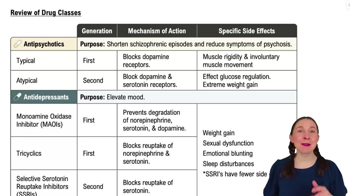
Medications primarily used for schizophrenia, targeting dopamine and serotonin receptors to reduce psychosis symptoms.
Track progress
Control buttons has been changed to "navigation" mode.
1/15
Related flashcards
Related practice
Recommended videos
Biological Therapies quiz #1
Biological Therapies
12 Terms
Biological Therapies
15. Treatment
7 problems
Topic
Nicole
Psychotherapy
15. Treatment
7 problems
Topic
15. Treatment
4 topics
12 problems
Chapter
Nicole
Guided course
01:55
Example 3
575
views
1
rank
Guided course
03:40
Review of Drug Classes
370
views
3
rank
Guided course
02:31
Drug Therapies
483
views
3
rank
Terms in this set (15)
Hide definitions
Antipsychotics
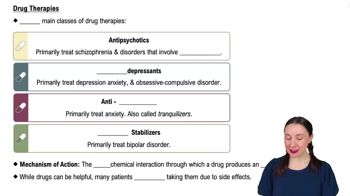
Medications primarily used for schizophrenia, targeting dopamine and serotonin receptors to reduce psychosis symptoms.
Antidepressants
Medications designed to elevate mood and energy, often by altering serotonin, norepinephrine, or dopamine activity.
Benzodiazepines
Drugs known as tranquilizers, enhancing GABA activity to produce rapid calming effects for anxiety.
Mood Stabilizers
Medications, such as lithium, used to manage both manic and depressive episodes in bipolar disorder.
Mechanism of Action
The specific biochemical process through which a drug produces its therapeutic effect in the brain.
Side Effects
Unintended, often unpleasant, physiological or psychological reactions resulting from medication use.
Selective Serotonin Reuptake Inhibitors
Second-generation antidepressants, commonly prescribed, that block serotonin reabsorption to boost mood.
Monoamine Oxidase Inhibitors
First-generation antidepressants that prevent breakdown of norepinephrine, serotonin, and dopamine.
Tricyclics
Older antidepressants that block reuptake of norepinephrine and serotonin, rarely used today due to side effects.
Tolerance
A phenomenon where increasing doses of a drug are needed to achieve the same therapeutic effect.
Placebo Effect
Improvement in symptoms resulting from the expectation of benefit rather than the drug's active ingredients.
Transcranial Magnetic Stimulation
A noninvasive procedure using magnetic fields to stimulate the prefrontal cortex, mainly for severe depression.
Electroconvulsive Therapy
A treatment involving controlled seizures induced by electrical currents, effective for severe, treatment-resistant depression.
Anterior Cingulotomy
A precise neurosurgical procedure creating a small lesion in the anterior cingulate cortex to alleviate severe depression or OCD.
Psychotherapy
A non-pharmacological intervention providing skills and insights to manage psychological symptoms, often combined with medication.
 BackBack
 01:55
01:55