Skip to main content
Introduction to Psychology
My Course
Learn
Exam Prep
AI Tutor
Study Guides
Flashcards
Explore
Try the app
My Course
Learn
Exam Prep
AI Tutor
Study Guides
Flashcards
Explore
Try the app
Back
Developmental Designs definitions
You can tap to flip the card.
Developmental Design
You can tap to flip the card.
👆
Developmental Design
A research framework used to study human change and growth across different periods of life.
Track progress
Control buttons has been changed to "navigation" mode.
1/15
Related flashcards
Related practice
Recommended videos
Developmental Designs quiz #1
Developmental Designs
11 Terms
Developmental Designs
2. Psychology Research
7 problems
Topic
Nicole
Evaluating Research Findings
2. Psychology Research
7 problems
Topic
Nicole
2. Psychology Research
5 topics
14 problems
Chapter
Nicole
Guided course
00:59
Developmental Designs Example 1
644
views
3
rank
Guided course
07:19
Developmental Designs
801
views
6
rank
Terms in this set (15)
Hide definitions
Developmental Design
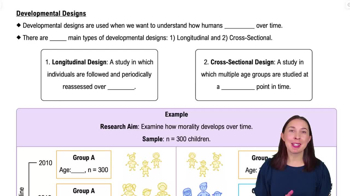
A research framework used to study human change and growth across different periods of life.
Longitudinal Design
A study approach where the same individuals are repeatedly assessed over months, years, or decades.
Cross-Sectional Design
A method comparing different age groups at a single time point to examine developmental differences.
Individual Development
Unique patterns of change and stability observed within a single person over time.
Temporal Precedence
The ability to determine that one variable occurs before another, strengthening causal inferences.
Attrition
Loss of participants from a study over time, potentially impacting data quality and sample representativeness.
Sampling Bias
A distortion in study results caused by non-random participant selection or dropout.
Convenience Sample
A group of participants who remain in a study due to motivation or availability, possibly reducing generalizability.
Developmental Psychology
A field focused on understanding how humans grow, change, and develop throughout life.
Causal Relationship
A connection where one variable directly influences another, though not always proven in developmental studies.
Research Validity
The degree to which study findings accurately reflect the phenomena being investigated.
Experimental Design
A research structure that can establish cause-and-effect by manipulating variables and controlling conditions.
Moral Problem Solving
Tasks or assessments used to evaluate ethical reasoning and decision-making in participants.
Data Collection
The process of gathering information from participants at specific time points or age groups.
Generalizability
The extent to which study results apply to broader populations beyond the sample studied.
 BackBack
 00:59
00:59