Skip to main content
Introduction to Psychology
My Course
Learn
Exam Prep
AI Tutor
Study Guides
Flashcards
Explore
Try the app
My Course
Learn
Exam Prep
AI Tutor
Study Guides
Flashcards
Explore
Try the app
Back
Obedience quiz
You can tap to flip the card.
What is obedience in psychology?
You can tap to flip the card.
👆
What is obedience in psychology?
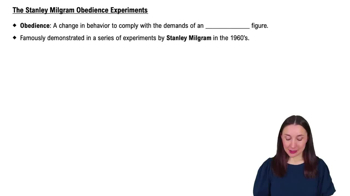
Obedience is a change in behavior to comply with the demands of an authority figure.
Track progress
Control buttons has been changed to "navigation" mode.
1/15
Related flashcards
Related practice
Recommended videos
Obedience definitions
Obedience
15 Terms
Obedience
12. Social Psychology
7 problems
Topic
Nicole
Social Forces
12. Social Psychology
7 problems
Topic
Nicole
12. Social Psychology - Part 1 of 2
3 topics
9 problems
Chapter
Nicole
12. Social Psychology - Part 2 of 2
3 topics
9 problems
Chapter
Nicole
Guided course
01:26
Example 1
441
views
Guided course
05:45
The Stanley Milgram Obedience Experiments
644
views
4
rank
Guided course
02:09
Factors That Affect Obedience
496
views
2
rank
Terms in this set (15)
Hide definitions
What is obedience in psychology?
Obedience is a change in behavior to comply with the demands of an authority figure.
Who conducted the famous obedience experiments in the 1960s?
Stanley Milgram conducted the famous obedience experiments.
What historical event inspired Milgram to study obedience?
Milgram was inspired by the Nazi trials after World War II, where many defendants claimed they were just following orders.
In Milgram's experiment, what roles were assigned to the participant and the confederate?
The participant was assigned the role of 'teacher' and the confederate was assigned the role of 'learner.'
How did the participant administer punishment in Milgram's study?
The participant administered electric shocks to the learner for incorrect answers using a fake shock box.
What percentage of participants continued to shock the learner after they began screaming?
About 80% of participants continued to shock the learner after they began screaming.
What percentage of participants delivered the highest possible voltage in Milgram's study?
About 62% of participants delivered the highest possible voltage.
How did Milgram ensure that participants were not unusually aggressive?
The study was advertised as a learning and memory study, so participants were expected to have average aggression levels.
What effect did having the learner in the same room as the participant have on obedience?
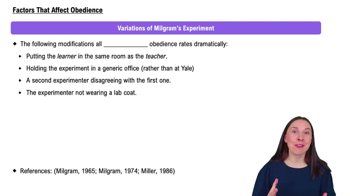
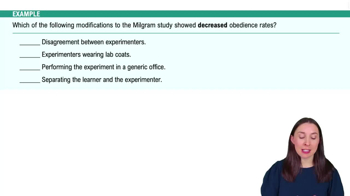
Having the learner in the same room led to lower obedience rates.
How did holding the experiment in a generic office building affect obedience?
Conducting the experiment in a generic office building lowered obedience rates compared to Yale's campus.
What happened to obedience rates when a second experimenter disagreed with the first?
Obedience rates decreased when a second experimenter disagreed with the first.
How did the experimenter's attire influence obedience?
Obedience rates were lower when the experimenter did not wear a lab coat.
What two main factors were found to decrease obedience in Milgram's study modifications?
Confronting the harm inflicted and lowering the perceived authority of the experimenter both decreased obedience.
Why did lowering the perceived authority of the experimenter reduce obedience?
Lower perceived authority made participants less likely to comply with instructions.
What ethical implications did Milgram's findings highlight?
Milgram's findings highlighted the ethical concerns of obedience, especially regarding harm and authority in social contexts.
 BackBack
 01:26
01:26