Skip to main content
Introduction to Psychology
My Course
Learn
Exam Prep
AI Tutor
Study Guides
Flashcards
Explore
Try the app
My Course
Learn
Exam Prep
AI Tutor
Study Guides
Flashcards
Explore
Try the app
Back
Schizophrenia quiz
You can tap to flip the card.
What is schizophrenia characterized by?
You can tap to flip the card.
👆
What is schizophrenia characterized by?
Schizophrenia is characterized by significant disturbances in thought, perception, emotion, and behavior.
Track progress
Control buttons has been changed to "navigation" mode.
1/15
Related flashcards
Related practice
Recommended videos
Schizophrenia definitions
Schizophrenia
15 Terms
Schizophrenia
14. Psychological Disorders
7 problems
Topic
Depression
14. Psychological Disorders
7 problems
Topic
14. Psychological Disorders
5 topics
11 problems
Chapter
Nicole
Guided course
02:06
Example 1
294
views
Guided course
04:07
Risk Factors
305
views
1
rank
Guided course
05:14
Schizophrenia
348
views
1
rank
Terms in this set (15)
Hide definitions
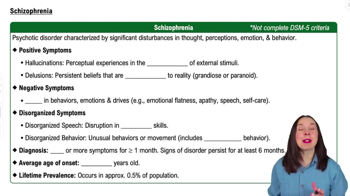
What is schizophrenia characterized by?
Schizophrenia is characterized by significant disturbances in thought, perception, emotion, and behavior.
What are the three main categories of symptoms in schizophrenia?
The three main categories are positive symptoms, negative symptoms, and disorganized symptoms.
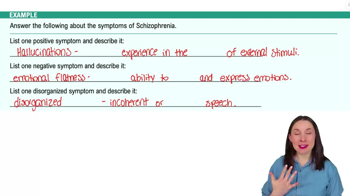
What are hallucinations in the context of schizophrenia?
Hallucinations are perceptual experiences that occur without any external stimuli, most commonly auditory.
What are delusions and what are two common types seen in schizophrenia?
Delusions are persistent beliefs contrary to reality; common types include grandiose and paranoid delusions.
How do positive symptoms differ from negative symptoms in schizophrenia?
Positive symptoms add abnormal experiences or behaviors, while negative symptoms involve a loss of normal behaviors or emotions.
What are some examples of negative symptoms in schizophrenia?
Examples include emotional flatness, apathy, decreased speech, and loss of self-care.
What is disorganized speech in schizophrenia?
Disorganized speech is a disruption in verbal skills, resulting in illogical or nonsensical language.
What is catatonic behavior in schizophrenia?
Catatonic behavior involves a loss of movement, where a person may freeze in an unusual position for a long time.
What is the typical age of onset for schizophrenia?
Schizophrenia usually begins between ages 18 and 35, often in the late teens to mid-twenties.
What is the lifetime prevalence of schizophrenia in the population?
Schizophrenia affects about 0.5% of the population.
What is required for a diagnosis of schizophrenia according to the discussed criteria?
Typically, two or more symptoms must persist for over one month, with signs lasting at least six months.
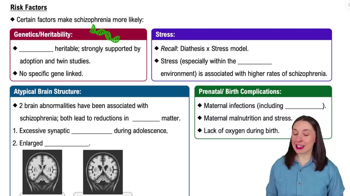
What evidence supports the genetic component of schizophrenia?
Adoption and twin studies show schizophrenia is highly heritable, though no specific gene has been identified.
How does stress relate to the development of schizophrenia?
Stress, especially early in life or within the family, is associated with higher rates of schizophrenia.
What brain abnormalities are associated with schizophrenia?
Schizophrenia is linked to excessive synaptic pruning and enlarged brain ventricles, both leading to reduced gray matter.
What prenatal and birth complications are associated with increased risk for schizophrenia?
Maternal infections, malnutrition, stress during pregnancy, and lack of oxygen during birth are associated with higher risk.
 BackBack
 02:06
02:06