Skip to main content
Introduction to Psychology
My Course
Learn
Exam Prep
AI Tutor
Study Guides
Flashcards
Explore
Try the app
My Course
Learn
Exam Prep
AI Tutor
Study Guides
Flashcards
Explore
Try the app
Back
The Humanist Perspective definitions
You can tap to flip the card.
Humanist Perspective
You can tap to flip the card.
👆
Humanist Perspective
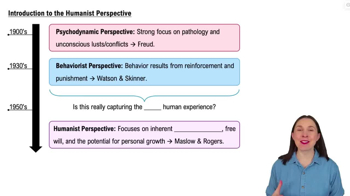
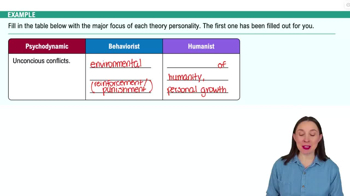
A psychological approach emphasizing inherent goodness, free will, and the drive for personal growth and fulfillment.
Track progress
Control buttons has been changed to "navigation" mode.
1/15
Related flashcards
Related practice
Recommended videos
The Humanist Perspective quiz #1
The Humanist Perspective
23 Terms
The Humanist Perspective
11. Personality
5 problems
Topic
11. Personality
3 topics
7 problems
Chapter
Nicole
Guided course
01:03
Example 1
274
views
1
rank
Guided course
01:40
Introduction to the Humanist Perspective
333
views
5
rank
Guided course
03:56
Humanistic Theories
313
views
3
rank
Terms in this set (15)
Hide definitions
Humanist Perspective
A psychological approach emphasizing inherent goodness, free will, and the drive for personal growth and fulfillment.
Psychodynamic Perspective
A viewpoint focusing on unconscious conflicts and negative aspects of human experience, especially pathology.
Behaviorist Perspective
A theory emphasizing behavior shaped by reinforcement and punishment, often minimizing unique human qualities.
Hierarchy of Needs
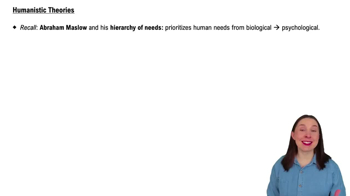
A model organizing human needs from basic biological requirements to advanced psychological fulfillment.
Self-Actualization
The process of creating a meaningful, satisfying life by realizing one's fullest potential.
Personal Growth
A lifelong process involving the pursuit of meaning, satisfaction, and the development of one's abilities.
Self-Concept
An individual's collection of thoughts and feelings about themselves, shaping personality and behavior.
Real Self
The objective version of a person, encompassing current thoughts, actions, and authentic characteristics.
Ideal Self
An envisioned version of oneself representing personal aspirations and the most perfect self-image.
Congruence
A state of alignment between one's real and ideal self, linked to higher self-worth and well-being.
Incongruence
A mismatch between real and ideal self, often resulting in maladjustment and lower psychological health.
Maladjustment
Poor psychological outcomes associated with a lack of consistency between one's real and ideal self.
Free Will
The capacity to make choices independently, central to the humanist view of personal agency.
Personal Meaning
A sense of significance and satisfaction derived from experiences and life pursuits.
Psychological Well-Being
A state of mental health associated with congruence, self-worth, and fulfillment of personal potential.
 BackBack
 01:03
01:03