Skip to main content
Introduction to Psychology
My Course
Learn
Exam Prep
AI Tutor
Study Guides
Flashcards
Explore
Try the app
My Course
Learn
Exam Prep
AI Tutor
Study Guides
Flashcards
Explore
Try the app
Back
Trait Theories definitions
You can tap to flip the card.
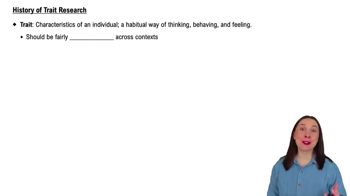
Trait
You can tap to flip the card.
👆
Trait
A consistent characteristic influencing thoughts, behaviors, or feelings, remaining stable across various situations and contexts.
Track progress
Control buttons has been changed to "navigation" mode.
1/13
Related flashcards
Related practice
Recommended videos
Trait Theories quiz #1
Trait Theories
22 Terms
The Humanist Perspective
11. Personality
5 problems
Topic
11. Personality
3 topics
7 problems
Chapter
Nicole
Guided course
05:13
The Big Five Factor Model
340
views
1
rank
Guided course
05:45
History of Trait Research
357
views
3
rank
Guided course
01:15
Example 2
239
views
3
rank
Terms in this set (13)
Hide definitions
Trait
A consistent characteristic influencing thoughts, behaviors, or feelings, remaining stable across various situations and contexts.
Central Trait
A core characteristic that defines personality, recognized by others and stable across all contexts.
Secondary Trait
A context-dependent characteristic, noticeable only in specific situations and not central to overall personality.
Factor Analysis
A statistical method used to identify underlying patterns in large sets of personality data.
Sixteen Personality Factors
A set of core characteristics identified by Cattell using statistical analysis to describe individual differences.
Introversion
A dimension reflecting reserved, quiet, and less sociable tendencies in personality.
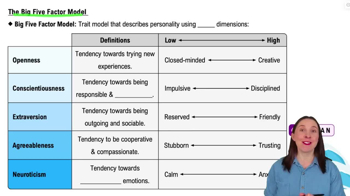
Extraversion
A dimension reflecting outgoing, sociable, and friendly tendencies in personality.
Neuroticism
A tendency toward experiencing negative emotions such as anxiety or pessimism, varying in intensity.
Stability
A dimension reflecting calmness and emotional steadiness, opposite of neuroticism.
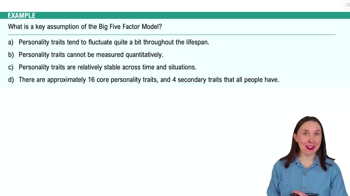
Big Five Factor Model
A widely accepted framework describing personality using five broad dimensions, validated across cultures.
Openness
A dimension indicating receptiveness to new experiences, creativity, and open-mindedness.
Conscientiousness
A dimension reflecting responsibility, reliability, and self-discipline in personality.
Agreeableness
A dimension reflecting cooperativeness, compassion, and trust toward others.
 BackBack
 05:13
05:13