Back
BackBehavioral and Cognitive Therapies: Principles, Applications, and Effectiveness
Study Guide - Smart Notes
 Tailored notes based on your materials, expanded with key definitions, examples, and context.
Behavior Therapy
Overview of Behavior Therapy
Behavior therapy emerged as a reaction to psychoanalysis and humanistic therapies, focusing on observable behaviors rather than underlying psychological processes. The central theory is that maladaptive behaviors themselves are the problem, not symptoms of deeper issues. Thus, the goal is to directly modify problematic behaviors.
No "symptom substitution": The approach assumes that eliminating a problematic behavior does not cause another to arise in its place.
Goal: To change maladaptive behaviors through learning principles.
Exposure and Systematic Desensitization
These are evidence-based techniques primarily used to treat anxiety disorders by gradually reducing fear responses.
Exposure Therapy: Involves gradual exposure to feared objects or situations, allowing anxiety to decrease over time (also called "flooding" when not gradual).
Response Prevention: Prevents the individual from engaging in avoidance or compulsive behaviors during exposure.
Systematic Desensitization: Combines gradual exposure with relaxation techniques to countercondition anxiety responses.
Counterconditioning: Replaces an unwanted response (e.g., fear) with a desired one (e.g., relaxation).
Aversion Therapy: Pairs unwanted behaviors with unpleasant stimuli to reduce their occurrence.
Operant Conditioning in Therapy
Operant conditioning techniques are used to increase or decrease specific behaviors by manipulating their antecedents and consequences.
Functional Analysis: Identifies the antecedents (A), behaviors (B), and consequences (C) to understand and modify behavior patterns.
Modification: Therapists change antecedents and consequences to reinforce desired behaviors and reduce undesired ones.
Example: A child with autism may receive rewards for making eye contact, increasing the likelihood of this behavior.

Behavior Modification Applications
Behavior modification is widely used for various populations and problems, including:
Autism Spectrum Disorder: Applied Behavior Analysis (ABA) techniques reinforce communication and social skills.
Antisocial Behavior in Children: Parent management training teaches parents to reinforce prosocial behaviors.
Token Economy: Individuals earn tokens for desired behaviors, which can be exchanged for rewards.
Cognitive Therapy
Principles of Cognitive Therapy
Cognitive therapy addresses the limitations of behavioral models by focusing on the role of thoughts and beliefs in psychological disorders. Founded by Albert Ellis and Aaron Beck, it posits that maladaptive thinking patterns contribute to emotional distress and behavioral problems.
Cognitive ABC Model: A (Activating event) → B (Beliefs) → C (Consequences). The way individuals interpret events (B) influences their emotional and behavioral responses (C).
Goal: To identify and modify distorted or unhelpful beliefs.
CBT: Treatment of Depression
Cognitive-behavioral therapy (CBT) integrates cognitive and behavioral techniques and is highly effective for depression and other disorders. It focuses on changing negative thought patterns and behaviors that maintain depression.

Sample Techniques in Cognitive Therapy
Socratic Dialogue: Therapists use guided questioning to help clients examine and challenge their beliefs.
Behavioral Experiments: Clients test the validity of their beliefs through real-life experiments.
Integration: Cognitive techniques are often combined with behavioral strategies for maximum effectiveness.
Newer Developments: Third Wave Therapies
Third wave therapies are modern CBT approaches that emphasize changing one's relationship to thoughts and feelings rather than the content of thoughts themselves.
Mindfulness-Based Approaches: Encourage nonjudgmental awareness of the present moment.
Acceptance and Commitment Therapy (ACT): Focuses on accepting thoughts and feelings while committing to valued actions.
Transdiagnostic Treatments: Designed to address common processes across multiple disorders (e.g., targeting avoidance in both depression and generalized anxiety disorder).
Effectiveness of Therapy
Research Designs in Therapy Evaluation
To determine whether therapy works, researchers use experimental designs with random assignment and control groups. This allows for objective measurement of therapy outcomes.
Control Groups: Help rule out placebo effects and natural recovery.
Outcome Measurement: Ideally uses standardized assessments before and after treatment.

Does Therapy Work?
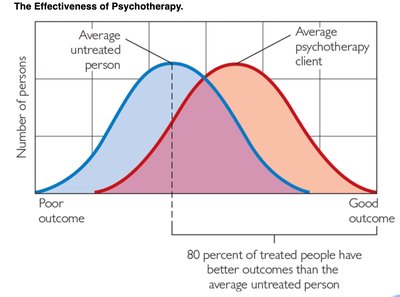
Research indicates that psychotherapy is generally effective. Meta-analyses, such as Smith & Glass (1980), show that treated individuals have better outcomes than untreated individuals.
Meta-Analysis: Combines results from multiple studies to estimate overall effectiveness.
Findings: About 80% of treated people fare better than the average untreated person.
Dodo Bird Verdict
The "Dodo bird verdict" refers to the claim that all therapy models are equally effective, based on the quote from Alice in Wonderland: "All have won, and all must have prizes." While many therapies are effective for many problems, behavioral and cognitive approaches are considered best for certain conditions, such as anxiety and depression. CBT is typically short-term and may not be sufficient for all individuals.

Therapy Compared to Other Treatments
Psychotherapy often works as well as or better than medication for many psychological problems. It is considered one of psychology's most important contributions to society.