 Back
BackIntroduction to Psychological Science: Foundations, Methods, and Perspectives
Study Guide - Smart Notes
 Tailored notes based on your materials, expanded with key definitions, examples, and context.
Chapter 1: Introducing Psychological Science
What is Psychology?
Psychology is the scientific study of behaviour and mental processes. It seeks to understand how individuals think, feel, and act, both as individuals and within groups. Psychology became a science by adopting systematic methods of observation, experimentation, and analysis.
Behaviour: Observable actions of humans and animals.
Mental Processes: Internal experiences such as thoughts, feelings, and motives.
Goal: To describe, explain, predict, and control behaviour.
Common Misconceptions
People often misinterpret behaviour, mistaking shyness for arrogance or friendliness for flirting. Psychology helps clarify these misunderstandings by applying scientific principles to human behaviour.
Goals of Psychology
Understand how brain structures work together
Explore the interaction of nature (genes) and nurture (environment)
Examine how past experiences shape thinking and actions
Study the influence of family, culture, and groups
Investigate how control affects health and happiness
Link all these factors to mental health
Many Perspectives in Psychology
Psychology examines behaviour from multiple perspectives, each contributing to a more comprehensive understanding:
Biological: Focuses on the brain, genetics, and physiological processes.
Cognitive: Examines thinking, memory, and information processing.
Sociocultural: Considers the impact of family, culture, and society.
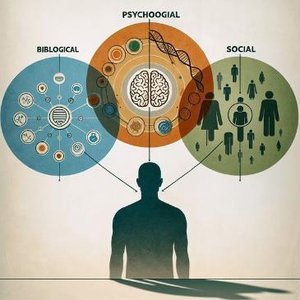
The Science of Psychology
Psychology as a Science
Psychology is grounded in evidence, not opinion. Research is conducted in both laboratory and real-world settings, and findings are published in scientific journals. The scientific method is the foundation of psychological research.
Knowledge is based on empirical evidence.
Findings are subject to replication and peer review.
How Psychology Became a Science
Philosophical Roots: Ancient philosophers like Plato and Aristotle pondered the mind and behaviour.
Wilhelm Wundt (1879): Established the first psychology laboratory, marking psychology's separation from philosophy.
Early Schools: Structuralism (analyzing the mind's structure) and Functionalism (studying the mind's functions).
20th Century Approaches: Psychoanalysis (Freud), Behaviourism (Watson, Skinner), Humanism (Rogers, Maslow).
Modern Era: Cognitive psychology, neuroscience, and the biopsychosocial model.
The Scientific Method in Psychology
What is the Scientific Method?
The scientific method is a systematic approach to understanding the world through observation, prediction, and testing. It is used across all sciences, including psychology.
Careful observation
Formulating hypotheses
Testing predictions through experiments
Building and revising theories

Hypotheses and Theories
Hypothesis: A testable prediction that is observable and measurable. It must be falsifiable (capable of being proven wrong).
Theory: A broad explanation that integrates multiple findings and generates new hypotheses. Theories can be supported or disproven.
Hypothesis | Theory |
|---|---|
Specific prediction (e.g., "Does X affect Y?") | Broad explanation (e.g., "Why/how does this happen?") |
Testable and falsifiable | Integrates many findings |
Can be supported or rejected | Can be supported or disproven |
Examples of Hypotheses and Theories
People are less likely to help if others are around (bystander effect).
Alcohol reduces sleep quality.
Exercise improves memory.

Classical Conditioning Example
Pavlov's Classical Conditioning Theory explains how associations form between stimuli and responses. For example, dogs learn to salivate at the sound of a bell if it predicts food.
Unconditioned stimulus (food) → Unconditioned response (salivation)
Conditioned stimulus (bell) + food → Salivation
Conditioned stimulus (bell) → Conditioned response (salivation)
The Biopsychosocial Model
Understanding Behaviour from Multiple Levels
The biopsychosocial model posits that behaviour is shaped by the interaction of biological, psychological, and social factors. All three levels influence behaviour simultaneously and interact with each other.
Biological: Brain, chemicals, hormones, genetics
Psychological: Memories, emotions, personality, thinking
Social: Family, peers, culture, society
Scientific Literacy and Critical Thinking
What is Scientific Literacy?
Scientific literacy is the ability to understand, analyze, and apply scientific information. It involves more than memorizing terms; it requires thinking like a scientist.
Learn new information
Explain concepts using scientific language
Think critically about evidence
Apply knowledge to real-life situations
Critical Thinking in Psychology
Critical thinking involves curiosity, skepticism, and the ability to evaluate evidence. It is essential for distinguishing strong evidence from weak claims and for making informed decisions.
Be curious and dig deeper
Check the source of information
Spot assumptions and biases
Avoid emotional thinking
Tolerate ambiguity
Consider alternative explanations
Historical and Modern Perspectives in Psychology
Philosophical and Scientific Origins
Empiricism: Knowledge comes from observation and experience.
Determinism: Behaviour has cause-and-effect relationships, shaped by internal and external factors.
Influences from Other Sciences
Physics: Gustav Fechner studied sensation and perception, founding psychophysics.
Evolutionary Biology: Charles Darwin's theory of evolution explained adaptive functions of behaviour.
Medicine: Brain injuries and localization of function (Broca, Wernicke, Phineas Gage) linked brain and behaviour.
Statistics: Sir Francis Galton pioneered measurement of individual differences, raising nature vs. nurture debates.
The Rise of Behaviourism
Pavlov: Classical conditioning in dogs.
Watson: Promoted behaviourism, focusing on observable behaviour.
Skinner: Radical behaviourism, emphasizing rewards and punishments.
Social and Cultural Influences
Social Psychology: How others influence behaviour (e.g., obedience, prejudice).
Cognitive Revolution: Focus on mental processes (memory, thinking, language).
Humanistic Psychology: Emphasizes individual uniqueness, free will, and personal growth (Rogers, Maslow).
The Brain and Behaviour
Hebb's Law: "Cells that fire together, wire together." Learning changes brain structure.
Penfield: Mapped brain functions using electrical stimulation.
Neuroimaging: EEG and fMRI allow visualization of brain activity, leading to fields like cognitive and social neuroscience.
Psychology of Women and Cross-Cultural Psychology
Research on gender roles, stereotypes, and women's health.
Cross-cultural psychology studies how behaviour differs across cultures.
Indigenous perspectives highlight the importance of cultural context and history in shaping well-being.
Positive Psychology
Positive psychology focuses on strengths, growth, and flourishing. It aims to promote self-acceptance, improve relationships, and increase happiness and fulfillment.
Linked to better cognitive abilities and resilience.
Helps with motivation and coping with stress.
Summary Table: Major Perspectives in Psychology
Perspective | Focus | Key Figures |
|---|---|---|
Biological | Brain, genetics, physiology | Hebb, Penfield |
Cognitive | Thinking, memory, language | Neisser, Chomsky |
Behavioural | Learning, observable behaviour | Pavlov, Watson, Skinner |
Humanistic | Personal growth, free will | Rogers, Maslow |
Sociocultural | Culture, society, groups | Triplett, Bem |
