 Back
Introduction to Psychology: Consciousness, Learning, Memory, Thinking, Motivation, and Emotion
Study Guide - Smart Notes
 Tailored notes based on your materials, expanded with key definitions, examples, and context.
Consciousness and Sleep
Biological Rhythms and Circadian Rhythms
Consciousness refers to our awareness of ourselves, our thoughts, and our environment. Biological rhythms are regular fluctuations in physiological functioning, governed by internal biological clocks and influenced by external cues such as light and temperature. The most prominent biological rhythm is the circadian rhythm, which operates on a roughly 24-hour cycle and regulates sleep-wake patterns, body temperature, hormone levels, and other bodily functions.
Endogenous rhythms are generated from within and persist even without external cues.
The suprachiasmatic nucleus (SCN) in the hypothalamus acts as the biological clock, receiving information about light and dark and regulating hormones like melatonin.
Internal desynchronization occurs when biological rhythms are out of phase, such as during jet lag or shift work.
Chronotype refers to individual differences in sleep-wake preferences (early birds vs. night owls).
Sleep Stages and Functions
Sleep is divided into several stages, each characterized by distinct brain wave patterns observable via EEG. Sleep serves restorative functions, including waste removal, cell repair, energy conservation, immune strengthening, and memory consolidation.
Stage 1: Light sleep, small and irregular brain waves.
Stage 2: Sleep spindles, rapid bursts of high-peaking waves.
Stages 3/4: Deep sleep, delta waves, slow with high peaks.
REM (Rapid Eye Movement): Vivid dreams, rapid and irregular brain waves, muscle paralysis.
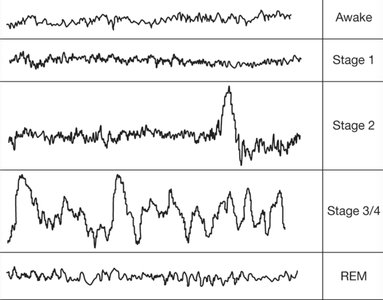
Sleep loss increases stress hormones, impairs attention, mood, creativity, and may cause hallucinations.
Sleep disorders include sleep apnea (breathing stops), narcolepsy (unpredictable sleep attacks), and REM behavior disorder (acting out dreams).
Dreams and Theories
Dreams occur mainly during REM sleep. Theories about dreams include:
Freud's theory: Dreams reflect unconscious conflicts and wishes.
Problem-focused approach: Dreams help resolve waking concerns.
Cognitive approach: Dreaming is a modification of waking cognitive activity.
Activation-synthesis theory: Dreams result from spontaneous neural activity in the pons during REM sleep.
Hypnosis
Hypnosis is a procedure in which a practitioner suggests changes in sensations, thoughts, feelings, or behavior. Theories include:
Dissociation theory: Split in consciousness, with a hidden observer.
Sociocognitive theory: Effects result from social influence and subject's expectations.
Biological theory: EEG studies show alpha waves during hypnosis.
Psychoactive Drugs
Psychoactive drugs alter perception, mood, thinking, or behavior by affecting neurotransmitter activity in the brain.
Stimulants: Increase CNS activity (e.g., meth, cocaine, nicotine, caffeine).
Depressants: Decrease CNS activity (e.g., alcohol, tranquilizers).
Opiates: Relieve pain (e.g., heroin, morphine).
Psychedelics: Disrupt thought processes (e.g., LSD, marijuana).
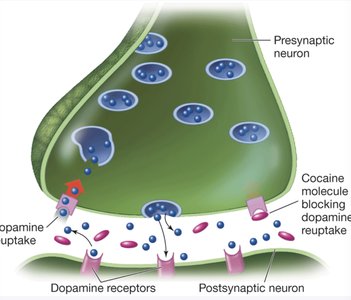
Drugs act by increasing/decreasing neurotransmitter release, blocking reuptake, or interfering with receptors.
Tolerance: Needing more of the drug for the same effect.
Withdrawal: Physical and psychological symptoms when stopping the drug.
Learning
Classical Conditioning
Classical conditioning (Pavlovian conditioning) is learning based on association between a neutral stimulus and an unconditioned stimulus.
Unconditioned stimulus (US): Naturally elicits a response.
Unconditioned response (UR): Natural response to US.
Conditioned stimulus (CS): Initially neutral, elicits response after association.
Conditioned response (CR): Response to CS after conditioning.
Extinction: CR declines if CS is not paired with US.
Spontaneous recovery: CR reappears after extinction.
Stimulus generalization: Similar stimuli elicit similar responses.
Stimulus discrimination: Different responses to similar stimuli.
Operant Conditioning
Operant conditioning involves learning through consequences of behavior.
Reinforcement: Increases likelihood of behavior.
Punishment: Decreases likelihood of behavior.
Primary reinforcers: Satisfy biological needs (food, water).
Secondary reinforcers: Associated with primary (money, praise).
Extinction: Response declines when reinforcement is withdrawn.
Shaping: Reinforcing successive approximations toward desired behavior.
Social-Cognitive Theory and Observational Learning
Learning also occurs through observation and imitation of others, influenced by beliefs, perceptions, and social context.
Latent learning: Not immediately expressed.
Observational learning: Learning by watching others.
Memory
Information Processing Models
Memory involves encoding, storing, and retrieving information. The three-box model describes three stages:
Sensory register: Briefly holds sensory information.
Working memory: Temporarily holds and manipulates information (up to 30 seconds).
Long-term memory: Stores information permanently, organized by semantic categories.
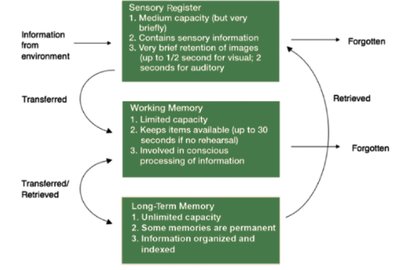
Types of Memory
Explicit (declarative) memory: Facts and events (semantic and episodic).
Implicit (nondeclarative) memory: Skills and procedures (classical conditioning, priming, procedural memory).
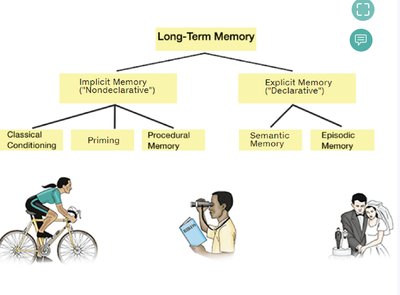
Serial-Position Effect
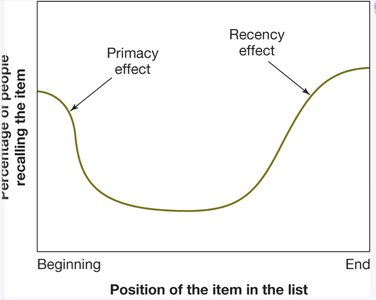
People tend to recall the first (primacy effect) and last (recency effect) items in a list better than those in the middle.
Neural Basis of Memory
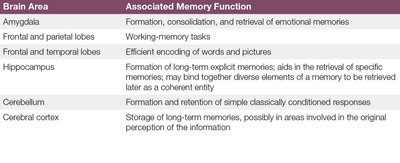
Memory formation involves chemical and structural changes at synapses. Different brain areas are responsible for different memory functions.
Brain Area | Associated Memory Function | ||
|---|---|---|---|
Amygdala | Formation, consolidation, and retrieval of emotional memories | ||
Frontal and parietal lobes | Working-memory tasks | ||
Frontal and temporal lobes | Efficient encoding of words and pictures | ||
Hippocampus | Formation of long-term explicit memories; binds diverse elements | ||
Cerebellum | Formation and retention of simple classically conditioned responses | ||
Cerebral cortex | Storage of long-term memories | ||
Forgetting
Forgetting occurs due to decay, replacement, interference, or lack of retrieval cues. Retroactive interference is when new information interferes with old, and proactive interference is when old information interferes with new.
Thinking and Intelligence
Concepts and Cognitive Schemas
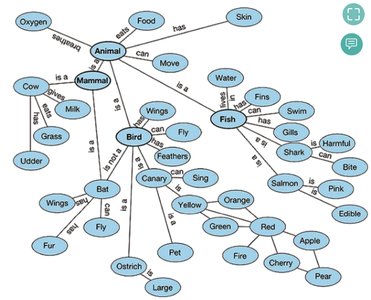
Thinking involves manipulating mental representations of knowledge. Concepts group objects, activities, or qualities with common properties. Cognitive schemas are frameworks for organizing information.
Types of Thinking
Conscious thinking: Awareness of mental processes.
Subconscious thinking: Outside awareness, can be brought into consciousness.
Nonconscious thinking: Remains outside awareness.
Heuristics and Biases
Heuristics are mental shortcuts for decision-making. Common biases include:
Availability heuristic: Judging probability by ease of recall.
Confirmation bias: Favoring information that confirms beliefs.
Hindsight bias: Believing you "knew it all along" after an event.
Framing effect: Decisions influenced by how choices are presented.
Intelligence
Intelligence is the ability to profit from experience, acquire knowledge, and adapt to changes. It is measured by standardized tests and inferred from behavior.
Crystallized intelligence: Knowledge and skills, stable or increases with age.
Fluid intelligence: Reasoning and problem-solving, decreases with age.
Motivation
Types of Motivation
Motivation is the process that moves an organism toward a goal or away from an unpleasant situation.
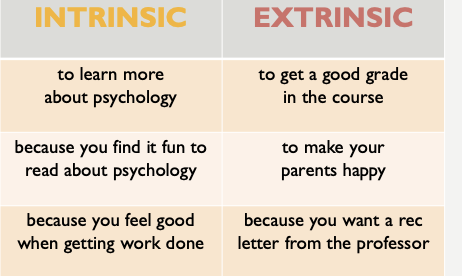
Intrinsic motivation: Doing something for its own sake and pleasure.
Extrinsic motivation: Doing something for external rewards.
INTRINSIC | EXTRINSIC |
|---|---|
to learn more about psychology | to get a good grade in the course |
because you find it fun to read about psychology | to make your parents happy |
because you feel good when getting work done | because you want a rec letter from the professor |
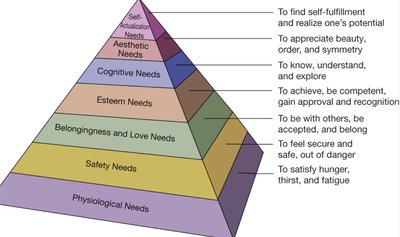
Maslow's Hierarchy of Needs
Maslow's hierarchy organizes human needs from basic physiological needs to self-actualization.
Motivation and Work
Intrinsic motivation predicts quality of work, while extrinsic incentives predict quantity. Task significance increases job performance, and diversity in groups can enhance problem-solving.
Emotion
The Nature of Emotion
Emotions are physiological, cognitive, and behavioral responses to significant events. They evolved to help us meet challenges and communicate with others.
Physiological changes: Brain, face, and body responses.
Cognitive processes: Appraisals and interpretations.
Subjective feelings: Personal experience of emotion.
Action tendencies: Motivation to act (fight, flee).
Culture and social context: Influence expression and experience.
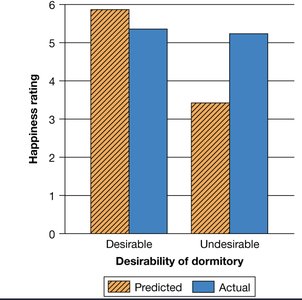
Brain Areas and Emotion
The amygdala evaluates sensory information and triggers emotional responses. The cortex regulates and interprets emotions. Mirror neurons help us understand others' emotions.
Emotion and Gender
Gender differences in emotion are shaped by stereotypes and cultural norms. Women may express emotions more verbally, while men may express anger more freely.
Additional info:
Memory consolidation involves structural changes in the hippocampus and other brain regions.
Sleep facilitates learning and memory, and sleep deprivation impairs cognitive performance.
Motivation and emotion are influenced by biological, cognitive, cultural, and interpersonal factors.
