 Back
BackParenting Styles, Family Structure, and Child Development: Study Notes
Study Guide - Smart Notes
 Tailored notes based on your materials, expanded with key definitions, examples, and context.
Parenting Styles
Maccoby and Martin’s Four Parenting Styles
Parenting styles are classified based on levels of responsiveness and demandingness. Maccoby and Martin expanded Baumrind’s original model to four distinct styles:
Authoritative: High responsiveness and high demandingness. Parents set clear standards but are supportive and encourage independence.
Authoritarian: Low responsiveness, high demandingness. Parents enforce strict rules and expect obedience, often with little warmth.
Permissive: High responsiveness, low demandingness. Parents are indulgent and may avoid setting boundaries.
Uninvolved/Neglectful: Low responsiveness, low demandingness. Parents are disengaged, providing little guidance or attention.
Example: Authoritative parents use inductive discipline, helping preschoolers gain control of their behavior, but this is not equally effective for all children.
Parenting Styles in Context
Jay Belsky’s process model (1984) emphasizes that parenting is influenced by three main contexts:
Parent characteristics: Adult personality traits affect parenting style.
Child characteristics: Child temperament can influence parental responses; hostile parenting may reinforce difficult temperament.
Sources of family stress and support: External stressors (e.g., COVID-19 quarantines) can increase authoritarian parenting and children’s anxiety.
Parent training programs can help break harmful interaction patterns. External sources of stress and support are crucial in shaping parenting behaviors.
Power Assertion
Power assertion is a strategy where parents use their authority to change children’s behavior, including physical punishment, scolding, or manipulating privileges.
Physical punishment: Increases risk of aggressive behavior in children.
Other forms: May induce anxiety or guilt.
Developmentalists’ view: Most oppose physical punishment due to its negative developmental outcomes.
Factors Associated with Parenting Styles
Parenting styles are affected by social and cultural variables. Authoritative parenting is linked to positive developmental outcomes across groups.
Race, Ethnicity, and Socioeconomic Status: Authoritative style is most common among White, middle-class, two-parent families; least common among Asian Americans.
Outcomes: Teenagers from authoritative families show more self-reliance and less delinquency.
Authoritarian style: Linked to school performance and social competence in some groups.
Parenting Goals and Cultural Context
Parenting styles are grounded in specific goals, which may vary by culture:
Asian American parents: Authoritarian style may help children succeed economically and maintain ethnic identity.
African American parents: Authoritarian style may prepare children for bias and provide cultural empowerment.
Cultural context: Parenting styles are deployed within broader cultural frameworks.
Family Structure
Two-Parent Families
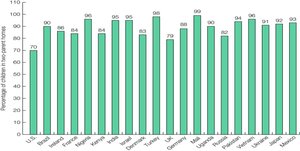
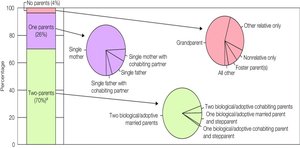
The two-parent family remains dominant in the U.S., but family structures are increasingly diverse. Children may live with biological, adoptive, or step-parents, and arrangements can include cohabitation or remarriage.
Single-Parent Families
Single-parent families are common, with 20% headed by single fathers and 80% by single mothers. Single-mother families typically have lower incomes and are more likely to experience food insecurity.
Coparenting agreements: Legal arrangements for equitable caregiving and expenses.
Income disparities: Average taxable income for single-mother families is $35,000; for single-father families, $56,000.
Race, Ethnicity, and Family Structure
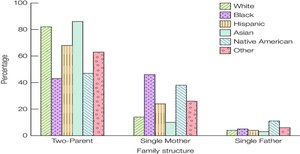
Family structure varies across racial and ethnic groups. Sociologists suggest economic opportunity influences family roles, especially among Black men. Some groups emphasize kin orientation, involving extended family in parenting.
Families Headed by Gay and Lesbian Parents
Nearly 300,000 families are headed by same-sex couples. Female couple-headed households are more likely to include children than male couple-headed households. Studies show few differences in child outcomes across family types.
Income: Same-sex couples with children have higher average incomes and fewer children.
Single parents: Similar characteristics regardless of orientation.
Custodial Grandparents
Over 7 million grandparents are fully responsible for raising grandchildren. Custodial grandparents are more concerned about end-of-life planning and child welfare. Developmental outcomes for children raised by grandparents are not well understood due to confounding variables.
Multigenerational Families
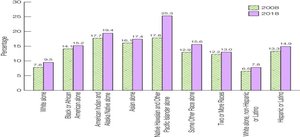
About 10% of children live in multigenerational households, often due to economic hardship, immigration, or caregiving needs. Outcomes vary across groups, and more adults aged 18–30 are living with parents.
Divorce and Child Development
Effects of Divorce on Children
Divorce is traumatic for children, but negative factors may predate the divorce. Children are affected by multiple divorce-related factors, including interparental conflict and emotional swings.
Stress: Parental conflict raises child’s stress levels.
Behavior: Teens may spend more time online and experience video game addiction.
Long-term effects: Adults may doubt their ability to sustain long-term relationships.
Understanding the Effects of Family Structure and Divorce
The risk-resilience approach emphasizes that parenting style, rather than family disruption, is significant for child outcomes. Parents can mitigate risk factors by including children in pre-divorce counseling and engaging extended family for support.
Resilience: Supportive parenting and emotional support can buffer negative effects.
Peer Relationships in Early Childhood
Phenomenon of Play
Play is the predominant form of behavior in early childhood. Through play, children learn social skills and understand both positive and negative aspects of relationships.
Development: Play helps children develop skills needed to relate to others.
Stages: Parten’s stages of play describe the progression of social play behaviors.
Parenting Style | Responsiveness | Demandingness | Typical Outcomes |
|---|---|---|---|
Authoritative | High | High | Self-reliance, social competence |
Authoritarian | Low | High | Obedience, lower self-esteem |
Permissive | High | Low | Poor impulse control |
Uninvolved | Low | Low | Low social competence |
Family Structure | Key Characteristics | Developmental Outcomes |
|---|---|---|
Two-parent | Biological/adoptive, married/cohabitating | Varied, often positive |
Single-parent | Mother or father, lower income | Higher risk of food insecurity |
Same-sex parents | Higher income, fewer children | Few differences found |
Custodial grandparents | Grandparent as primary caregiver | Outcomes unclear |
Multigenerational | Multiple generations in household | Varied outcomes |
Stage of Play | Description |
|---|---|
Solitary Play | Child plays alone |
Parallel Play | Children play side by side, but not together |
Associative Play | Children interact, share toys, but activities are not coordinated |
Cooperative Play | Children play together in organized activities |
