 Back
CH. 11: Personality: Theories, Traits, and Perspectives
Study Guide - Smart Notes
 Tailored notes based on your materials, expanded with key definitions, examples, and context.
Personality
Definition and Concept
Personality refers to the long-standing traits and patterns that propel individuals to consistently think, feel, and behave in specific ways. It encompasses one’s general style of interacting with the world and other people. The term originates from the Latin word persona, meaning a mask worn by an actor, symbolizing the different roles or faces people present in various situations.

Key Point: Personality is stable over time and across situations.
Key Point: It is shaped by both internal (biological, psychological) and external (social, cultural) factors.
Example: A person may be described as outgoing and friendly by close friends, but reserved by strangers.
Historical Approaches to Personality
Phrenology: Franz Gall
Franz Gall proposed that the distances between bumps on the skull could reveal a person’s personality traits, character, and mental abilities. Although this theory was later discredited due to lack of empirical support, it was an early attempt to link biology and personality.
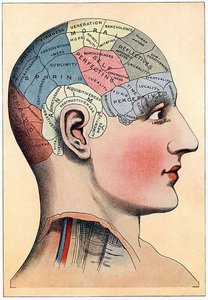
Key Point: Phrenology suggested specific brain regions corresponded to traits.
Key Point: Modern neuroscience has shown that personality is not determined by skull shape.
Wilhelm Wundt: Axes of Personality
Wilhelm Wundt suggested personality could be described using two major axes: emotional/non-emotional and changeable/unchangeable. This model divided temperaments into four types: melancholic, choleric, phlegmatic, and sanguine.
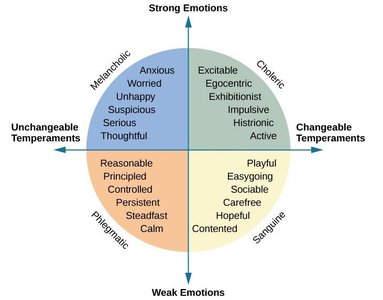
Key Point: Melancholic and choleric types have strong emotions; phlegmatic and sanguine have weak emotions.
Key Point: Choleric and sanguine are changeable; melancholic and phlegmatic are unchangeable.
Example: A sanguine person is sociable and carefree, while a melancholic person is thoughtful and serious.
Psychodynamic Perspectives
Sigmund Freud
Freud developed the first comprehensive theory of personality, explaining both normal and abnormal behaviors. He proposed that unconscious drives, influenced by sex, aggression, and childhood experiences, shape personality. Personality results from efforts to balance biological aggression and pleasure-seeking behavior.
Key Point: Unconscious motives and conflicts are central to personality development.
Key Point: Freud’s theory introduced concepts like the id, ego, and superego.
Karen Horney: Coping Styles and Anxiety
Karen Horney focused on unconscious anxiety, suggesting that normal growth is inhibited by anxiety stemming from unmet needs. She identified three styles of coping used by children to relieve anxiety: moving towards people (compliance), moving against people (aggression), and moving away from people (withdrawal).
Moving towards people (Compliance): Seeking affiliation, affection, and approval; as adults, intense need for love and interdependence.
Moving against people (Aggression): Seeking power, manipulation, and social recognition; as adults, may exploit others.
Moving away from people (Withdrawal): Seeking independence, self-sufficiency, and perfectionistic control; as adults, may avoid relationships.
Trait Theories
The Five-Factor Model (Big Five)
The Five-Factor Model describes personality using five independent trait dimensions: Openness to experience, Conscientiousness, Extraversion, Agreeableness, and Neuroticism. Each trait exists on a continuum from low to high.
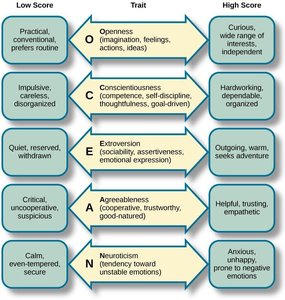
Openness: Imagination, feelings, actions, ideas
Conscientiousness: Competence, self-discipline, goal-driven
Extraversion: Sociability, assertiveness, emotional expression
Agreeableness: Cooperative, trustworthy, good-natured
Neuroticism: Tendency toward unstable emotions
Big Five Scores and Age
Research shows that Big Five trait scores change across the lifespan. For example, conscientiousness and agreeableness tend to increase with age, while neuroticism decreases.
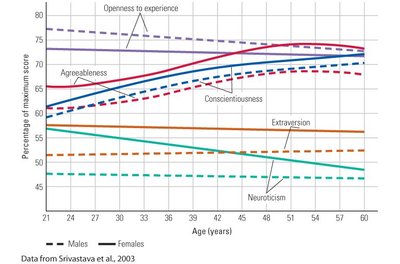
Key Point: Personality traits are relatively stable but can change over time.
Example: Older adults often score higher in conscientiousness and agreeableness.
Socially Aversive Traits: The Dark Triad
Narcissism, Machiavellianism, Psychopathy
The Dark Triad refers to three socially aversive personality traits: narcissism (extreme selfishness and need for admiration), Machiavellianism (manipulative, callous, goal-oriented behavior), and psychopathy (amoral, antisocial behavior, lack of empathy).
Narcissism: Overt (grandiose) and covert (vulnerable) types.
Machiavellianism: Manipulation and deception for personal gain.
Psychopathy: Lack of empathy, impulsivity, shallow affect.
Key Point: All three traits are associated with antagonistic personalities (low agreeableness).
Social-Cognitive Theories
Self-Efficacy
Self-efficacy refers to beliefs about one’s own ability to perform specific tasks. Developed through social experiences, self-efficacy affects how individuals approach challenges and persevere.
Key Point: High self-efficacy leads to greater persistence and achievement.
Grit
Grit is defined as perseverance and passion for long-term goals. Angela Duckworth and colleagues proposed that grit is a higher-order personality trait, independent from IQ, and predictive of success in various domains.

Perseverance of effort: Continued effort despite setbacks.
Consistency of interest: Sustained interest in long-term goals.
Locus of Control
Locus of control refers to beliefs about the power individuals have over the outcomes of their lives. An internal locus of control is associated with the belief that outcomes are the result of one’s own efforts, while an external locus of control attributes outcomes to external factors like luck or other people.

Internal locus: Greater independence, academic achievement, health, and lower depression.
External locus: Belief that outcomes are outside of personal control.
Humanistic and Biological Approaches
Humanistic Approach
The humanistic approach focuses on how healthy people develop. Abraham Maslow and Carl Rogers emphasized self-actualization, congruence between ideal and real self, and characteristics such as creativity, compassion, and acceptance.
Key Point: Emphasizes personal growth and fulfillment.
Biological Approach
Biological approaches focus on environmental factors and maturation affecting personality expression. Two important dimensions of temperament are reactivity (response to new stimuli) and self-regulation (control of responses and emotions).
Key Point: Temperament is foundational to adult personality.
Cross-Cultural Differences in Personality
Individualist vs. Collectivist Cultures
Personality expression varies across cultures. Individualist cultures value independence and personal achievement, while collectivist cultures value social harmony and group needs.
Individualist cultures: United States, England, Australia
Collectivist cultures: Asia, Africa, South America
Key Point: Cultural context shapes personality traits and behaviors.
Summary Table: Major Personality Theories
Theory | Main Features | Key Figures |
|---|---|---|
Psychodynamic | Unconscious drives, childhood experiences | Freud, Horney |
Trait | Stable characteristics, Big Five traits | Allport, Costa & McCrae |
Social-Cognitive | Learning, cognition, self-efficacy, locus of control | Bandura, Rotter |
Humanistic | Personal growth, self-actualization | Maslow, Rogers |
Biological | Temperament, genetic influences | Eysenck |
