 Back
BackPersonality: Traits, Biological Approaches, and Psychodynamic Theory
Study Guide - Smart Notes
 Tailored notes based on your materials, expanded with key definitions, examples, and context.
Personality Traits
Definition and Approaches
Personality refers to characteristic patterns of thinking, feeling, and behaving that are unique to an individual and remain relatively consistent over time and across situations. Psychologists study personality using two main approaches:
Idiographic Approach: Focuses on detailed descriptions of an individual's unique personality traits.
Nomothetic Approach: Examines large groups to make generalizations about personality structure.
Personality tests are commonly used to assess traits, but some, like those producing vague or universally applicable results, may be subject to the Barnum effect—the tendency to accept general statements as personally meaningful.


The Five Factor Model (OCEAN)
The Five Factor Model, also known as the Big Five, is a widely accepted framework for understanding personality. The five major traits are:
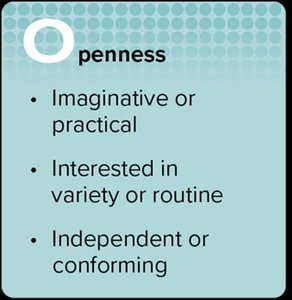
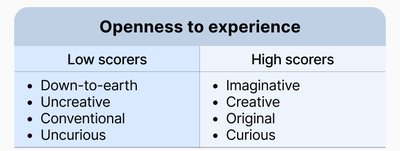
Openness to Experience: Imaginative, curious, open to new experiences.
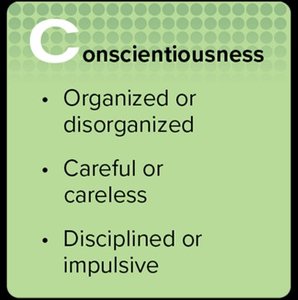
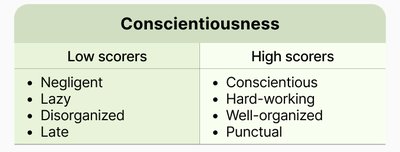
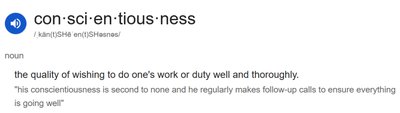
Conscientiousness: Organized, dependable, disciplined.
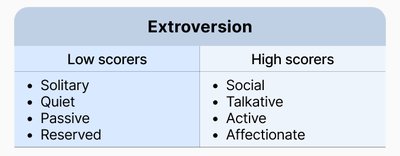
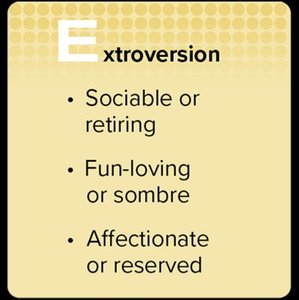
Extraversion: Outgoing, energetic, sociable.
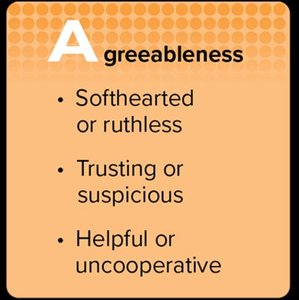
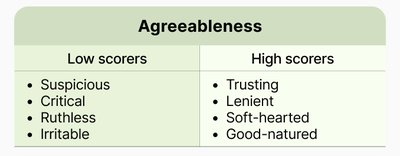
Agreeableness: Compassionate, cooperative, trusting.
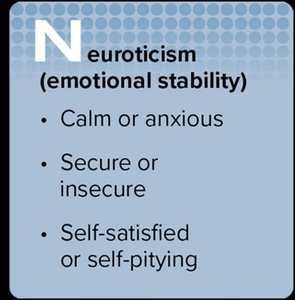
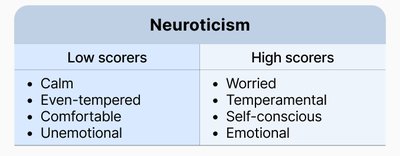
Neuroticism (Emotional Stability): Prone to emotional instability, anxiety, moodiness.
Each trait exists on a continuum, and individuals can score high or low on each dimension.
Trait Correlates and Applications
Openness: Linked to cognitive functioning, creativity, and adaptability.
Conscientiousness: Associated with health, longevity, goal achievement, and lower risk behaviors.
Extraversion: Related to relationship satisfaction, well-being, and social engagement.
Agreeableness: Promotes teamwork, social harmony, and relational investment.
Neuroticism: Associated with stress, poor sleep, and lower well-being.
Other Trait Models
HEXACO Model: Expands the Big Five by adding Honesty-Humility (HH).
The Dark Triad: Consists of Machiavellianism, psychopathy, and narcissism—traits associated with manipulative and antisocial behavior.



Personality Across the Lifespan
Temperament and Stability
Temperament refers to early-appearing, stable individual differences in emotional reactivity and self-regulation. Common temperament types include:
Well-adjusted: Self-controlled, confident, adaptable.
Under-controlled: Impulsive, restless, emotionally volatile.
Inhibited: Socially uncomfortable, fearful, easily upset by new situations.
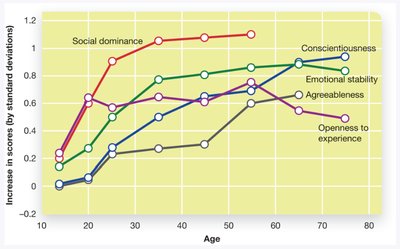
Personality traits show both stability and change across the lifespan, with some traits (e.g., conscientiousness) tending to increase with age.
Biological Approaches
Genetics and Heritability
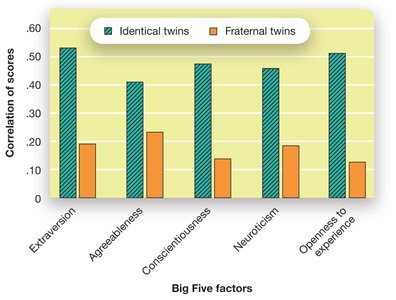
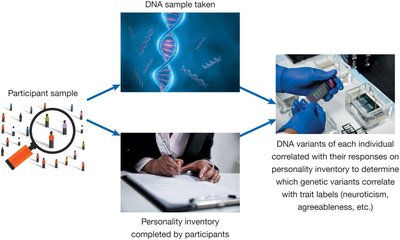
Genetic studies, including twin and adoption studies, demonstrate that personality traits are moderately heritable. Identical twins show higher correlations in personality traits than fraternal twins, suggesting a genetic component.
Evolution and Animal Personality
Evolutionary psychology explores why personality traits may have developed as adaptive responses. For example, animal studies (e.g., in the great tit, Parus major) show individual differences in exploration and risk-taking, suggesting that personality exists across species.

Arousal Theory and the Brain
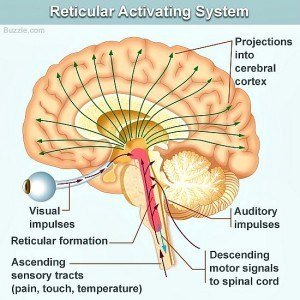
The arousal theory of extraversion posits that extraversion is determined by an individual's threshold for arousal, regulated by the Ascending Reticular Activating System (ARAS). The Behavioral Activation System (BAS) and Behavioral Inhibition System (BIS) are neural systems that influence approach and avoidance behaviors, respectively.
Psychodynamic Approach (Freud)
Freud's Model of the Psyche
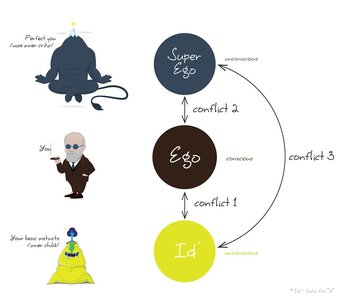
Freud proposed that personality is shaped by unconscious conflicts among three structures:
Id: Operates on the pleasure principle, seeking immediate gratification.
Ego: Operates on the reality principle, mediating between the id and superego.
Superego: Represents internalized moral standards and ideals.
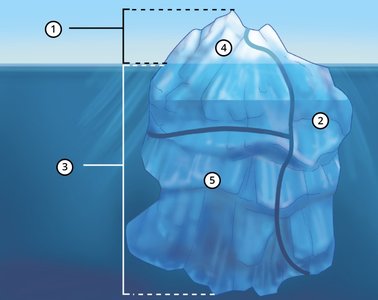
Much of the psyche is unconscious, influencing behavior outside of awareness. Freudian slips are examples of unconscious processes surfacing in speech or action.

Defence Mechanisms
Defence mechanisms are unconscious strategies used by the ego to reduce anxiety and protect the self from distressing thoughts or feelings. Common mechanisms include:
Denial: Refusing to acknowledge unpleasant realities.
Displacement: Redirecting impulses to a safer target.
Identification: Adopting characteristics of a more powerful person.
Projection: Attributing one's own unacceptable qualities to others.
Rationalization: Justifying behaviors with plausible but false reasons.
Reaction Formation: Transforming an unacceptable impulse into its opposite.
Repression: Burying distressing thoughts in the unconscious.
Sublimation: Channeling unacceptable impulses into socially acceptable activities.
Psychosexual Stages of Development
Freud theorized that personality develops through a series of psychosexual stages, each characterized by the erogenous zone that is the focus of pleasure:
Oral Stage (0-18 months): Focus on oral activities; fixation can lead to dependency or aggression.
Anal Stage (18 months-3 years): Focus on bowel control; fixation can result in orderliness or messiness.
Phallic Stage (3-6 years): Focus on genitals; Oedipus complex and identification with same-sex parent.
Latency Stage (6-13 years): Sexual impulses are repressed; focus on social and intellectual skills.
Genital Stage (puberty onward): Mature sexual interests develop.
Fixation at any stage can result in personality issues related to that stage.
