Back
BackSocial and Personality Development in Early Childhood: Key Theories, Family, and Peer Influences CH. 8
Study Guide - Smart Notes
 Tailored notes based on your materials, expanded with key definitions, examples, and context.
Social and Personality Development in Early Childhood
Theories of Social and Personality Development
Understanding social and personality development in early childhood involves examining several theoretical perspectives. These theories provide frameworks for interpreting how children develop emotionally, socially, and cognitively during the preschool years.
Psychoanalytic Perspectives: Focus on internal drives and emotions as the primary forces behind developmental change. Freud emphasized the anal and phallic stages, where children gain bodily control and renegotiate parental relationships. Erikson highlighted the stages of autonomy vs. shame and doubt, and initiative vs. guilt, stressing the balance between autonomy and parental control.
Social-Cognitive Perspectives: Assert that social and personality development is closely linked to cognitive growth. Key concepts include person perception (classifying others by traits, age, gender, race), understanding rule categories (distinguishing social conventions from moral rules), and grasping others’ intentions (differentiating intentional from unintentional actions).
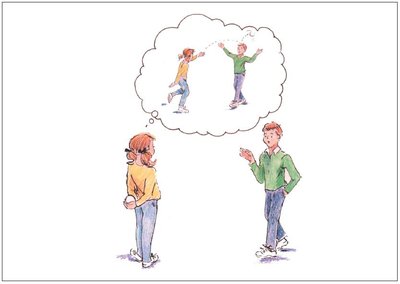
Example: Young children may judge a peer more harshly for breaking a rule on purpose than by accident, reflecting their developing understanding of intention.
Family Relationships and Structure
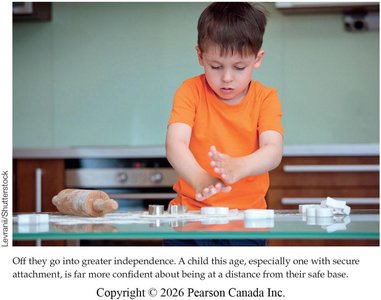
Family relationships are foundational to early childhood development, providing both continuity and change as children seek independence while maintaining attachment. Bowlby’s attachment theory highlights the ongoing influence of early bonds, which generalize as children grow.
Attachment Quality: Secure attachment predicts fewer behavioral problems and more positive relationships with teachers and peers. Insecure attachment is linked to aggression and negative self-attitudes.
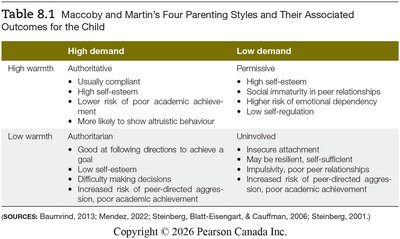
Parenting Styles: Diana Baumrind and later Maccoby & Martin identified four main parenting styles based on warmth and control:
High Demand | Low Demand | |
|---|---|---|
High Warmth | Authoritative - Usually compliant - High self-esteem - Lower risk of poor academic achievement - More likely to show altruistic behaviour | Permissive - High self-esteem - Social immaturity in peer relationships - Higher risk of emotional dependency - Low self-regulation |
Low Warmth | Authoritarian - Good at following directions - Low self-esteem - Difficulty making decisions - Increased risk of aggression, poor academic achievement | Uninvolved - Insecure attachment - May be resilient, self-sufficient - Impulsivity, poor peer relationships - Highest risk of aggression, poor academic achievement |
Discipline: Effective discipline is debated, with the Canadian Paediatric Society defining it as training that develops self-control and moral character. The effectiveness of discipline varies by child temperament and context.

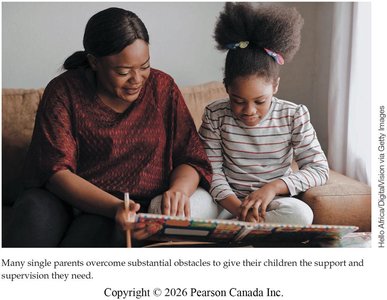
Family Structure: The quality of relationships is more predictive of child wellbeing than family structure. Single-parent, skip-generation, same-sex, and multigenerational households each present unique dynamics, but supportive relationships are key to positive outcomes.
Divorce: Divorce can be traumatic, with effects mediated by factors such as parental conflict, poverty, and routine disruption. Extended family support can serve as a protective factor.
Peer Relationships and Play
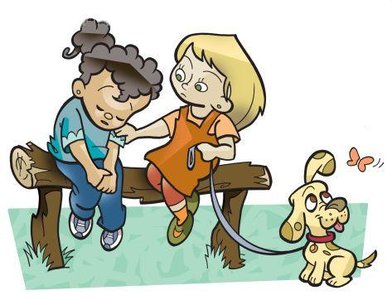
Peer relationships become increasingly important from ages 2 to 6, with play serving as a critical context for social skills development. Social skills are behaviors that facilitate acceptance by peers, and social-skills training can improve emotional regulation.
Play: Facilitates cognitive and social development. Children with poor group entry skills may be rejected, but training can help.
Aggression
Aggression is behavior intended to harm others or objects. Physical aggression peaks at age 2, while indirect aggression (e.g., gossiping) increases through age 11. Both forms often co-occur, and early high physical aggression predicts later indirect aggression.
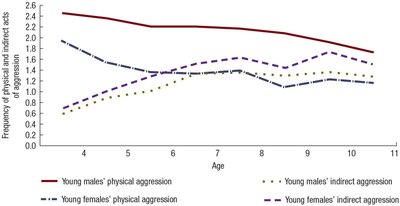
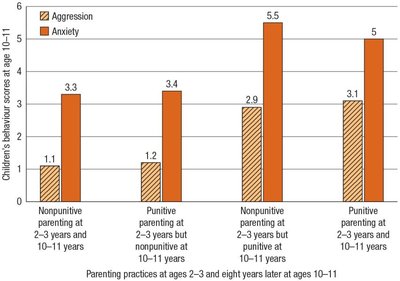
Factors: Aggression runs in families, is linked to harsh parenting, and is influenced by reinforcement and modeling. Epigenetic theory suggests both genetic predispositions and environmental influences are important.
Prosocial Behaviour and Friendships
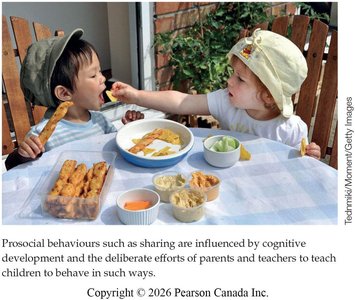
Prosocial behaviour, or altruism, is evident by age 2 or 3 and increases with age. Empathy and emotion regulation are key, and parental modeling and encouragement foster prosocial actions.
Friendships: Stable friendships begin to form in early childhood and are linked to later social competence.

Personality and Self-Concept
As children’s understanding of the social world grows, their temperaments develop into more complex personalities. Self-concept becomes more nuanced, allowing for greater self-regulation and independence.
Effortful Control: The ability to control impulses is crucial for social success. Parental responses to temperament shape personality development.
Categorical Self: Young children focus on visible characteristics when describing themselves and others.
Emotional Self: Emotional regulation shifts from parental to self-control, with empathy and moral emotions playing key roles.
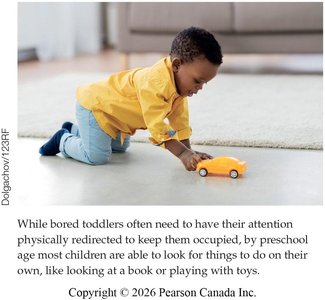
Social Self: Children develop social scripts and engage in sociodramatic play, which fosters independence and social understanding.
Gender Development
Gender development involves understanding the psychological and social implications of biological sex. By 18-24 months, children show preferences for gender-typical toys, and understanding of gender roles becomes a developmental priority.
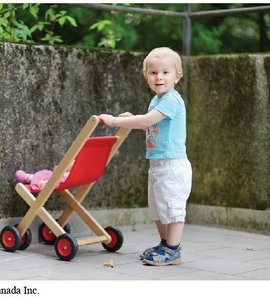
Socialization Theories: Emphasize the role of differential treatment and gendered messages in shaping gender roles. Caregivers play a significant role, but social learning alone is insufficient.
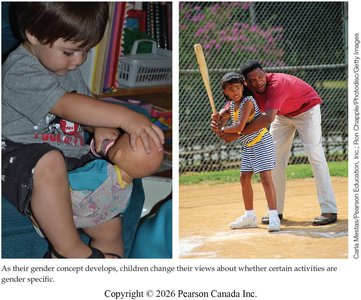
Cognitive Theories: Kohlberg’s concept of gender constancy (understanding that gender is stable across time and situations) is central. By age 7, most children grasp this concept.
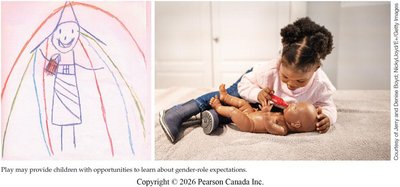
Information-Processing Approach: Gender schema theory posits that children use schemas to process gender-related information, first learning broad distinctions and later developing more complex views of both genders.
Biological Theories: Both prenatal and postnatal hormone levels (e.g., testosterone) predict gendered behaviors. Gender diversity includes cisgender, cross-gender behavior, and transgender identities, reflecting the complexity of gender development.