 Back
BackThinking, Language, Intelligence, Development, Emotion, and Motivation: Psychology Study Notes
Study Guide - Smart Notes
 Tailored notes based on your materials, expanded with key definitions, examples, and context.
Thinking, Language, Intelligence
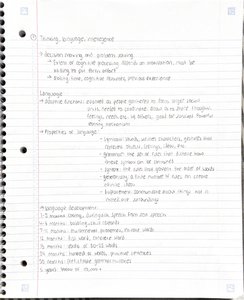
Decision Making and Problem Solving
Decision making and problem solving are core aspects of cognitive psychology, involving the processes by which individuals select among alternatives and find solutions to challenges.
Driven by cognitive shortcuts: Heuristics are mental shortcuts that help in making quick decisions.
Solving problems: Involves identifying, evaluating, and executing solutions.
Example: Using the "rule of thumb" to estimate answers in math problems.
Language
Language is a structured system of communication, essential for expressing thoughts, sharing information, and social interaction. It is governed by rules and consists of spoken, written, or signed forms.
Properties of Language:
Semanticity: Words convey meaning.
Generativity: Infinite combinations of words and sentences.
Displacement: Ability to talk about things not present.
Language Development:
Babbling (6 months)
One-word stage (12 months)
Two-word stage (24 months)
Telegraphic speech (2+ years)
Example: Children progress from babbling to forming sentences as they grow.
Intelligence
Theories of Intelligence
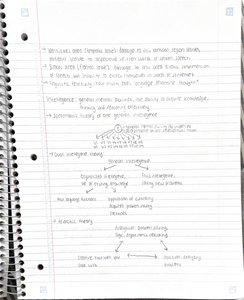
Intelligence is the ability to learn, reason, solve problems, and adapt to new situations. Psychologists have proposed various theories to explain its nature.
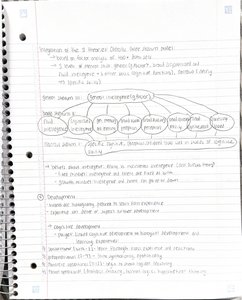
Spearman's g: General intelligence factor underlying all cognitive abilities.
Gardner's Multiple Intelligences: Intelligence is composed of distinct modalities (e.g., linguistic, logical-mathematical, spatial).
Sternberg's Triarchic Theory: Intelligence consists of analytical, creative, and practical components.
Emotional Intelligence: Ability to perceive, understand, manage, and use emotions effectively.
Example: Someone may excel in music (musical intelligence) but not in math (logical-mathematical intelligence).
Measuring Intelligence
Intelligence is measured using standardized tests that assess various cognitive abilities.
IQ (Intelligence Quotient): Score derived from standardized tests.
Reliability: Consistency of test results.
Validity: Accuracy in measuring intelligence.
Example: The Stanford-Binet and Wechsler scales are widely used intelligence tests.
Human Development
Cognitive Development
Cognitive development refers to the growth of mental abilities such as thinking, reasoning, and problem-solving throughout the lifespan.
Piaget's Stages:
Sensory-motor (birth-2 years): Learning through senses and actions.
Preoperational (2-7 years): Symbolic thinking, egocentrism.
Concrete operational (7-11 years): Logical thinking about concrete events.
Formal operational (12+ years): Abstract reasoning.
Example: Children in the preoperational stage may struggle with understanding conservation of volume.
Social and Emotional Development
Social and emotional development involves learning to interact with others and manage emotions.
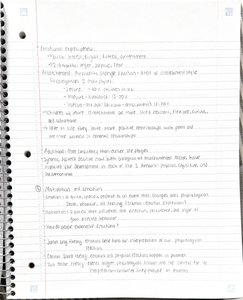
Attachment: Emotional bond between child and caregiver.
Erikson's Stages: Eight stages of psychosocial development, each with a central conflict.
Example: Trust vs. mistrust in infancy sets the stage for future relationships.
Emotion and Motivation
Emotion
Emotions are complex psychological states involving physiological arousal, expressive behaviors, and conscious experience.
Theories of Emotion:
James-Lange: Emotion is the perception of physiological responses.
Cannon-Bard: Emotion and physiological responses occur simultaneously.
Schachter-Singer: Emotion is based on physiological arousal and cognitive interpretation.
Example: Feeling fear when seeing a snake, accompanied by increased heart rate.
Motivation
Motivation is the process that initiates, guides, and sustains goal-oriented behaviors. It can be driven by biological, emotional, social, and cognitive factors.
Types of Motivation:
Intrinsic: Driven by internal rewards (e.g., enjoyment).
Extrinsic: Driven by external rewards (e.g., money, praise).
Theories:
Drive Theory: Motivation arises from biological needs.
Maslow's Hierarchy of Needs: Motivation progresses from basic physiological needs to self-actualization.
Example: Studying for an exam to achieve good grades (extrinsic motivation).
Summary Table: Theories of Intelligence
The following table summarizes major theories of intelligence and their key features.
Theory | Main Features | Example |
|---|---|---|
Spearman's g | General intelligence factor | High scores across different cognitive tasks |
Gardner's Multiple Intelligences | Distinct types of intelligence (e.g., linguistic, spatial) | Musical intelligence in composers |
Sternberg's Triarchic Theory | Analytical, creative, practical intelligence | Solving math problems, inventing, managing people |
Emotional Intelligence | Perceiving and managing emotions | Effective leadership, empathy |
Summary Table: Piaget's Stages of Cognitive Development
Stage | Age Range | Main Features |
|---|---|---|
Sensory-motor | Birth-2 years | Learning through senses and actions |
Preoperational | 2-7 years | Symbolic thinking, egocentrism |
Concrete operational | 7-11 years | Logical thinking about concrete events |
Formal operational | 12+ years | Abstract reasoning |
Additional info: Academic context and expanded explanations were added to ensure completeness and clarity for exam preparation.
