Skip to main content
Introduction to Sociology
My Course
Learn
AI Tutor
Study Guides
Flashcards
Explore
Try the app
My Course
Learn
AI Tutor
Study Guides
Flashcards
Explore
Try the app
Back
Defining Global Inequality definitions
You can tap to flip the card.
Global Stratification
You can tap to flip the card.
👆
Global Stratification
A framework for analyzing patterns of social inequality between nations using economic, health, education, and political criteria.
Track progress
Control buttons has been changed to "navigation" mode.
1/15
Related flashcards
Recommended videos
Defining Global Inequality quiz
Defining Global Inequality
15 Terms
Guided course
05:56
Defining Global Inequality
138
views
Guided course
01:27
Defining Global Inequality Example 1
100
views
Terms in this set (15)
Hide definitions
Global Stratification
A framework for analyzing patterns of social inequality between nations using economic, health, education, and political criteria.
Social Inequality
A condition where resources, opportunities, and privileges are distributed unevenly among different nations or groups.
Economic Factors
Criteria such as income, wealth, and productivity used to compare and categorize nations in stratification systems.
Health
A dimension of stratification reflecting access to healthcare and overall well-being within a nation's population.
Education
A measure of access to learning opportunities and attainment levels, influencing a nation's position in global rankings.
Political Structure
The organization of government and authority, impacting how nations are classified in global stratification systems.
First World
A Cold War-era category for highly industrialized, capitalist nations, often seen as having superior living standards.
Second World
A classification for moderately industrialized nations with socialist governments, prominent during the Cold War.
Third World
A term for countries with low industrialization and diverse governments, often criticized for its lack of nuance and bias.
Gross National Income
A measure of a country's total income divided by its population, used to classify nations by average income levels.
High-Income Nations
Countries with the highest standards of living and GNI per person, typically above \$14,000, though values vary yearly.
Middle-Income Nations
Countries with average living standards and GNI per person between \$4,000 and \$14,000, reflecting moderate development.
Low-Income Nations
Countries with the lowest living standards and GNI per person below \$4,000, often facing widespread poverty.
Income Distribution
The way income is spread among a population, revealing disparities that average measures like GNI may obscure.
Poverty
A state where individuals or groups lack sufficient resources to meet basic living needs, prevalent in low-income nations.
 BackBack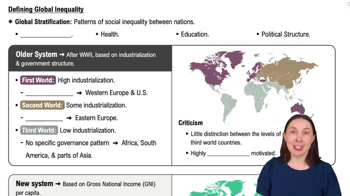
 05:56
05:56