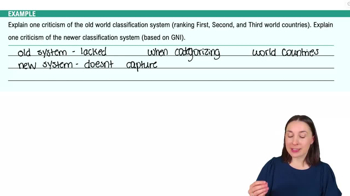
Global stratification is the study of patterns of social inequality between nations, often categorized by economic, health, education, and political factors.
Which factors are commonly used to stratify nations globally?
Economic factors are most common, but health, education, and political structure are also used to stratify nations.
What was the basis for the First, Second, and Third World classification system?
This system was based on levels of industrialization and government structure, with capitalist, socialist, and less industrialized nations grouped accordingly.
How were First World countries defined in the traditional system?
First World countries had high levels of industrialization and were typically capitalist, such as the US and Western Europe.
What characterized Second World countries in the old stratification system?
Second World countries had some industrialization and were generally socialist, including Eastern Europe and China.
How were Third World countries classified in the traditional system?
Third World countries had low industrialization and no specific governance pattern, often including Africa, South America, and parts of Asia.
Why is the First, Second, and Third World system criticized?
It lacks nuance, is politically motivated, and implies a ranking that unfairly portrays some countries as 'better' than others.
What is the modern system for classifying nations based on?
The modern system uses Gross National Income (GNI) to categorize countries as high-, middle-, or low-income.
How is Gross National Income (GNI) calculated?
GNI is calculated by dividing a country's total income by its population, giving an average income per person.
What GNI value defines a high-income nation?
High-income nations have a GNI of about \$14,000 per person or more, though values vary year to year.
What is the GNI range for middle-income nations?
Middle-income nations have a GNI between \$4,000 and \$14,000 per person.
What GNI value defines a low-income nation?
Low-income nations have a GNI below \$4,000 per person and a high percentage of people living in poverty.
What are some criticisms of the GNI-based stratification system?
It focuses only on income, excludes health and education, and does not account for inequality within countries.
Why can average income be misleading when measuring national wealth?
Averages can be skewed by outliers like billionaires, making the average income appear higher than most people's actual income.
Why is it important to consider factors beyond economic averages in global stratification?
Economic averages do not capture income distribution, poverty, or access to resources, which are crucial for understanding global inequality.
 Back
Back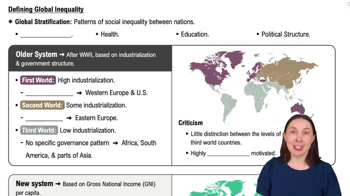
 05:56
05:56