What does the functionalist perspective say about the inevitability of deviance?
The functionalist perspective views deviance as an inevitable and normal part of society, necessary for clarifying social boundaries and enhancing social cohesion.
How does deviance serve a function in society according to functionalism?
Deviance clarifies social boundaries and increases social cohesion by uniting people against behaviors deemed unacceptable.
Which sociological theories are discussed under the functionalist perspective on deviance?
Durkheim's functions of deviance, strain theory, and social disorganization theory are discussed under the functionalist perspective.
How does the conflict perspective explain the origin of deviance?
The conflict perspective explains deviance as a response to inequality in wealth, power, or resources.
What role do formal negative sanctions play in the conflict perspective?
Formal negative sanctions are seen as tools of social control used to protect those in power and maintain existing inequalities.
According to the conflict perspective, why are social norms and laws created?
Social norms and laws are often designed to protect the interests of those in power and prevent lower-power individuals from gaining resources.
How does the conflict perspective view the political nature of deviance?
The conflict perspective sees deviance as politically motivated, with definitions of deviance serving to maintain power structures.
What is the focus of the symbolic interactionist perspective on deviance?
The symbolic interactionist perspective focuses on micro-level social interactions and how deviance is learned and defined through these interactions.
How does the symbolic interactionist perspective view the variability of deviance?
It sees deviance as variable and dynamic, depending on context, social circumstances, and the society in which it occurs.
Which theories are associated with the symbolic interactionist perspective on deviance?
Differential association theory, labeling theory, and control theory are associated with the symbolic interactionist perspective.
What is the main idea behind differential association theory?
Differential association theory suggests that deviance is learned through interactions with others who engage in deviant behavior.
What does labeling theory propose about deviance?
Labeling theory proposes that deviance is the result of society labeling certain behaviors or individuals as deviant.
How does social control relate to deviance?
Social control refers to the mechanisms, such as sanctions and norms, that societies use to regulate behavior and discourage deviance.
What is the significance of stigma in understanding deviance?
Stigma is a powerful social label that can mark individuals as deviant and affect their interactions and opportunities in society.
How does social stratification connect to theories of deviance?
Social stratification, or the hierarchical arrangement of individuals in society, is central to understanding how power dynamics influence definitions and responses to deviance.
 Back
Back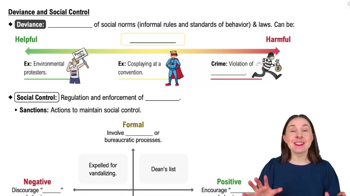
 04:11
04:11