Skip to main content
Introduction to Sociology
My Course
Learn
Exam Prep
AI Tutor
Study Guides
Flashcards
Explore
Try the app
My Course
Learn
Exam Prep
AI Tutor
Study Guides
Flashcards
Explore
Try the app
Back
Economic Systems quiz
You can tap to flip the card.
What is the primary characteristic of capitalism regarding ownership of resources and production?
You can tap to flip the card.
👆
What is the primary characteristic of capitalism regarding ownership of resources and production?
In capitalism, natural resources and the means of producing goods and services are primarily under private ownership.
Track progress
Control buttons has been changed to "navigation" mode.
1/15
Related flashcards
Related practice
Recommended videos
Economic Systems definitions
Economic Systems
20 Terms
Economic Systems
17. Work and Economy
5 problems
Topic
Sectors of the Economy
17. Work and Economy
5 problems
Topic
17. Work and Economy
3 topics
9 problems
Chapter
Guided course
01:56
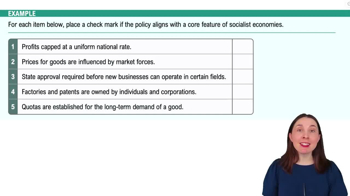
Economic Systems Example 3
72
views
Guided course
01:11
Economic Systems Example 2
63
views
Guided course
03:38
Socialism
80
views
Terms in this set (15)
Hide definitions
What is the primary characteristic of capitalism regarding ownership of resources and production?
In capitalism, natural resources and the means of producing goods and services are primarily under private ownership.
What is the profit motive in a capitalist economy?
The profit motive is the drive for individuals and businesses to seek personal gain through work, investment, and enterprise.
How are prices and supply regulated in an ideal capitalist economy?
Prices and supply are regulated by market forces, competition, and consumer choice rather than direct government control.
Why are heavy regulations and profit caps not aligned with capitalism?
They limit market-based decision making and reduce the influence of consumer choice and competition.
What is welfare capitalism?
Welfare capitalism is an economic system that combines a market-based economy with extensive government regulation and social welfare programs.
Give an example of a social welfare program commonly found in welfare capitalist systems.
Universal health care or child care are examples of social welfare programs in welfare capitalist systems.
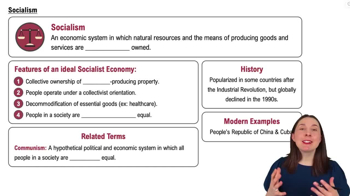
What is the main feature of socialism regarding ownership?
In socialism, natural resources and the means of producing goods and services are collectively owned, typically by the government.
How do people typically behave in a socialist society?
People are expected to work for the common good of society rather than for personal profit.
What does decommodification of essential goods mean in socialism?
It means the government makes essential goods like housing, food, and health care accessible to all people equally.
How does income equality in socialism compare to capitalism?
Income gaps are much smaller in socialism, with less disparity between different types of jobs compared to capitalism.
What historical event led some countries to adopt socialism?
The Industrial Revolution and the resulting income inequality led some countries to adopt socialism.
Name two modern countries commonly labeled as socialist.
The People's Republic of China and Cuba are commonly labeled as socialist countries.
How does communism differ from socialism in terms of equality?
Communism proposes both economic and social equality, aiming for a classless society, while socialism focuses on relative economic equality.
Why is communism considered a hypothetical system?
Because achieving complete social equality is difficult, as someone must hold power in government, making true classlessness unattainable.
What is a key criticism of government involvement in capitalist economies?
Too much government involvement is believed to reduce the quality and quantity of goods by interfering with market regulation.
 BackBack
 01:56
01:56