Back

Formal Organizations quiz

Control buttons has been changed to "navigation" mode.
1/15
  • What are formal organizations and why are they important in modern society?

    Formal organizations are secondary groups with established rules and procedures that achieve goals; they are essential for the functioning of modern society, providing services like utilities, mail, and food distribution.
  • What is a utilitarian organization?

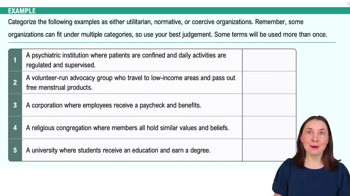
    A utilitarian organization is one people join primarily for monetary rewards or material benefits, such as businesses, government agencies, and schools.
  • What defines a normative organization?

    Normative organizations are joined based on shared morals, interests, or values, and are usually volunteer-based, like community or political groups.
  • What is a coercive organization?

    Coercive organizations involve forced membership, often as punishment or treatment, such as prisons or mental hospitals.
  • How can perceptions affect the categorization of formal organizations?

    People's perceptions can lead them to categorize the same organization differently, depending on their role or experience within it.
  • What is bureaucracy in the context of formal organizations?

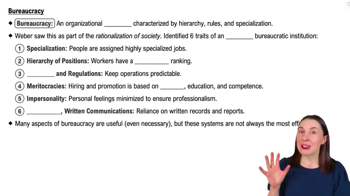
    Bureaucracy is an organizational model characterized by hierarchy, rules, and specialization, designed to maximize efficiency within formal organizations.
  • Who developed the concept of the ideal bureaucracy and what was its purpose?

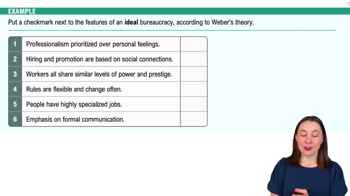
    Max Weber developed the concept of the ideal bureaucracy to describe a perfectly functioning organizational structure that supports rationalization and efficiency.
  • What is specialization in bureaucracy?

    Specialization means assigning people highly specific jobs, allowing them to fit into particular niches within the organization.
  • What does hierarchy of positions mean in a bureaucracy?

    Hierarchy refers to a vertical ranking of workers, where those higher up have more power, prestige, and typically higher pay.
  • Why are rules and regulations important in bureaucracies?

    Rules and regulations help optimize efficiency and keep operations predictable within bureaucratic organizations.
  • What is meritocracy in the context of bureaucracy?

    Meritocracy means hiring and promotion are based on skills, education, and competence, rather than family connections or lineage.
  • What does impersonality mean in bureaucratic organizations?

    Impersonality involves minimizing personal feelings and emotions to ensure professionalism and fair treatment for everyone.
  • Why is formal written communication important in bureaucracy?

    Formal written communication, such as paperwork and records, is crucial for optimizing efficiency and maintaining accurate records over time.
  • What is a criticism of bureaucracy in today's rapidly changing environment?

    Critics argue that bureaucracy can be too rigid and may not be efficient in environments where technology and conditions change quickly, suggesting more flexibility may be needed.
  • How do formal organizations and bureaucracy contribute to social structure?

    Formal organizations and bureaucracy shape social structure by organizing institutions like government, schools, and businesses, influencing organizational culture and societal functioning.