Skip to main content
Introduction to Sociology
My Course
Learn
AI Tutor
Study Guides
Flashcards
Explore
Try the app
My Course
Learn
AI Tutor
Study Guides
Flashcards
Explore
Try the app
Back
Forms of Government definitions
You can tap to flip the card.
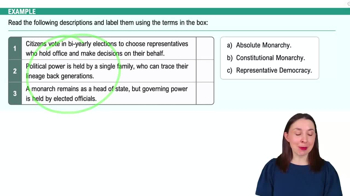
Monarchy
You can tap to flip the card.
👆
Monarchy
A political system where a single family holds power across generations, often with hereditary succession.
Track progress
Control buttons has been changed to "navigation" mode.
1/26
Related flashcards
Recommended videos
Forms of Government quiz
Forms of Government
15 Terms
Guided course
03:04
Monarchy and Democracy
48
views
Guided course
00:46
Forms of Government Example 2
50
views
Guided course
00:57
Forms of Government Example 1
48
views
Terms in this set (26)
Hide definitions
Monarchy
A political system where a single family holds power across generations, often with hereditary succession.
Absolute Monarchy
A regime where a monarch possesses unlimited authority, often seen in historical agrarian societies.
Constitutional Monarchy
A system where a monarch serves as a symbolic head of state, while elected officials govern and enforce laws.
Royal Family
A lineage that holds hereditary power in a monarchy, sometimes limited to ceremonial roles.
Democracy
A political system granting power to citizens, typically through voting and protection of civil rights.
Representative Democracy
A form of government where citizens elect officials to make laws and policies on their behalf.
Republic
A government structure where elected representatives act in the interests of the people.
Civil Liberties
Freedoms and rights protected in democratic societies, such as speech, assembly, and press.
Checks and Balances
A system designed to prevent concentration of power by distributing authority among branches or officials.
Limited Government
A principle restricting the power of elected officials, ensuring accountability and protection of rights.
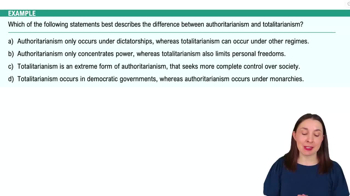
Authoritarianism
A political system with concentrated power in a leader or small group, often maintained through coercion.
Dictatorship
A regime where one individual holds all political power, often rising through charisma or military influence.
Totalitarianism
An extreme form of authoritarian rule seeking total control over society, including media and private life.
Single Party State
A regime type where one political party dominates, often associated with authoritarian features.
Coercion
The use of force or threats to maintain power and suppress opposition in non-democratic regimes.
Propaganda
Information manipulated by authorities to influence public opinion and maintain regime control.
Elite Status
A privileged position often used to gain and maintain power in authoritarian systems.
Imprisonment
A method used by regimes to punish dissenters and enforce obedience, especially in totalitarian states.
Symbolic Head of State
A figure representing national unity without governing authority, common in constitutional monarchies.
Political Power
Authority to make decisions and enforce policies within a government structure.
Elected Officials
Individuals chosen by citizens to govern and create laws in democratic systems.
Rigged Elections
Manipulated voting processes that undermine genuine citizen participation in authoritarian regimes.
Freedom of Speech
A civil liberty allowing individuals to express opinions without government interference.
Freedom of Assembly
A right enabling citizens to gather peacefully, often protected in democratic societies.
Freedom of Press
A civil liberty ensuring media can operate independently from government control.
Socialization
The process by which individuals learn societal norms, often politicized in totalitarian regimes.
 BackBack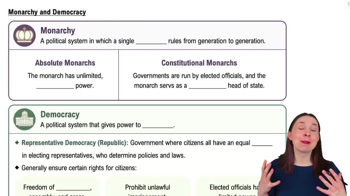
 03:04
03:04