What is one major way that public schools in the U.S. are funded, leading to inequality?
Public schools are funded through local property taxes, which results in wealthier districts having more resources than low-income districts.
What is 'teaching to the test' and why is it considered problematic?
'Teaching to the test' refers to focusing curriculum on passing standardized assessments rather than true mastery or critical thinking, which can limit students' transferable skills.
What was the primary goal of the Head Start program when it was founded in 1965?
Head Start aimed to reduce SES-based gaps in school readiness by providing early childhood education to low-income children.
How did the No Child Left Behind Act affect school funding?
It tied federal funding to standardized test scores, putting schools at risk of losing funding if they did not meet performance requirements.
What change did the Every Student Succeeds Act introduce compared to No Child Left Behind?
It shifted funding decisions from the federal government to the states, allowing more flexibility in how schools are funded.
What is functional illiteracy and how does it differ from illiteracy?
Functional illiteracy means being able to read words but struggling with comprehension and critical thinking, unlike illiteracy which is the inability to read at all.
What are some consequences of unequal school funding for students in low-income districts?
Students may face overcrowded classrooms, fewer advanced courses, limited extracurriculars, and outdated facilities, affecting their education and college competitiveness.
How do conflict theorists view the U.S. education system's role in society?
Conflict theorists argue that the education system reproduces inequality across generations by linking economic differences to educational and employment outcomes.
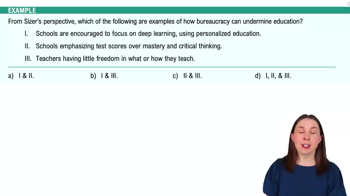
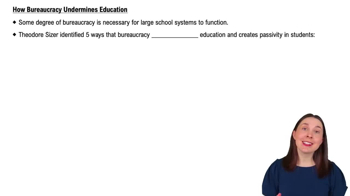
What are some criticisms of bureaucracy in U.S. schools according to Theodore Sizer?
Sizer criticized excessive rigidity, reliance on numbers for success, standardized grade progression, teacher specialization, and lack of accountability, all of which can undermine education.
How does teacher specialization in secondary schools affect student learning?
Students meet specialized teachers briefly, making it difficult for teachers to personalize education and get to know students well.
What is one suggested reform to counteract the negative effects of bureaucracy in schools?
Increasing flexibility and using more student-led approaches, such as allowing students to choose topics or how they demonstrate learning, are suggested reforms.
What are some educational advantages found in affluent school districts?
Affluent districts often have high-quality staff, smaller classes, advanced courses, arts and extracurriculars, and well-maintained facilities.
How do SES and racial gaps in education manifest in graduation rates?
White Americans have the highest college graduation rates, followed by Black Americans, with Hispanic Americans having the lowest, reflecting SES and racial gaps.
What is a downstream effect of limited extracurriculars and arts programs in low-income schools?
Students from low-income schools may appear less competitive on college applications, affecting their access to higher education and future opportunities.
Why is it difficult to evaluate the effectiveness of the Every Student Succeeds Act?
The Act gives states more flexibility, resulting in many variables that complicate broad or federal-level evaluation of its impact on academic outcomes.
 Back
Back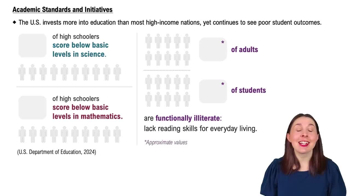
 04:00
04:00