Skip to main content
Introduction to Sociology
My Course
Learn
AI Tutor
Study Guides
Flashcards
Explore
Try the app
My Course
Learn
AI Tutor
Study Guides
Flashcards
Explore
Try the app
Back
Mate Selection quiz
You can tap to flip the card.
What is endogamy in mate selection?
You can tap to flip the card.
👆
What is endogamy in mate selection?
Endogamy is marrying within one's social category, such as class, race, or religion.
Track progress
Control buttons has been changed to "navigation" mode.
1/15
Related flashcards
Recommended videos
Mate Selection definitions
Mate Selection
15 Terms
Guided course
02:58
Mate Selection
79
views
Guided course
01:22
Mate Selection Example 1
85
views
Terms in this set (15)
Hide definitions
What is endogamy in mate selection?
Endogamy is marrying within one's social category, such as class, race, or religion.
What is exogamy in mate selection?
Exogamy is marrying outside one's social category, like a working class person marrying an upper class person.
In what type of social system is endogamy more common?
Endogamy is more common in closed systems where social hierarchy restricts mate selection.
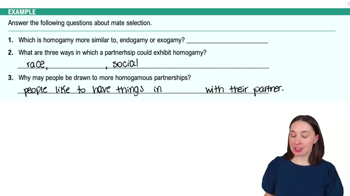
What is homogamy?
Homogamy is marrying someone similar to oneself in factors like class, race, ethnicity, or education.
Is homogamy present in cultures with endogamy or exogamy?
Yes, some level of homogamy is present regardless of whether endogamy or exogamy is more common.
What are the two main marriage structures identified by sociologists?
The two main marriage structures are monogamy and polygamy.
What is monogamy?
Monogamy is a marriage between two people.
Where is monogamy especially common?
Monogamy is especially common in high-income, highly industrialized nations.
What is polygamy?
Polygamy is a marriage involving more than two people.
What are the two types of polygamy?
The two types of polygamy are polygyny and polyandry.
What is polygyny?
Polygyny is a marriage with multiple wives.
What is polyandry?
Polyandry is a marriage with multiple husbands.
How can you remember the difference between polygyny and polyandry?
Polyandry involves more men, and 'andry' sounds like 'androgen,' a hormone associated with males.
How do social norms influence mate selection?
Social norms affect mate selection by shaping who individuals are likely to marry, even if they are not consciously aware of it.
Why is understanding mate selection important in sociology?
Understanding mate selection helps analyze social institutions and their role in shaping relationships and societal organization.
 BackBack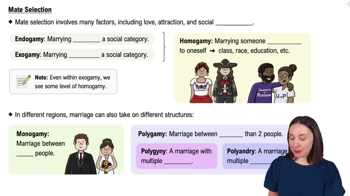
 02:58
02:58