Skip to main content
Introduction to Sociology
My Course
Learn
Exam Prep
AI Tutor
Study Guides
Flashcards
Explore
Try the app
My Course
Learn
Exam Prep
AI Tutor
Study Guides
Flashcards
Explore
Try the app
Back
Population Growth definitions
You can tap to flip the card.
Fertility Rate
You can tap to flip the card.
👆
Fertility Rate
Number of births in a population, often measured per 1,000 people annually, indicating potential for population increase.
Track progress
Control buttons has been changed to "navigation" mode.
1/15
Related flashcards
Related practice
Recommended videos
Population Growth quiz
Population Growth
15 Terms
Population Growth
19. Urbanization, Population, and Environment
5 problems
Topic
19. Urbanization, Population, and Environment
1 topic
3 problems
Chapter
Guided course
02:24
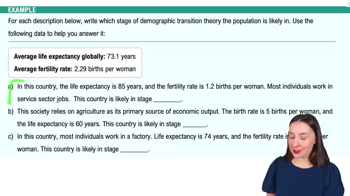
Population Growth Example 1
101
views
Guided course
02:52
Population Growth Example 3
104
views
Guided course
03:04
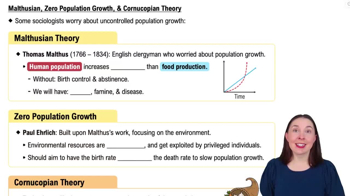
Malthusian, Zero Population Growth, & Cornucopian Theory
149
views
Terms in this set (15)
Hide definitions
Fertility Rate
Number of births in a population, often measured per 1,000 people annually, indicating potential for population increase.
Mortality Rate
Number of deaths in a population, typically measured per 1,000 people per year, reflecting population decline potential.
Crude Birth Rate
Annual count of live births per 1,000 individuals, used to estimate overall reproductive activity in a population.
Crude Death Rate
Annual count of deaths per 1,000 individuals, used to assess the rate at which a population loses members.
Population Pyramid
Graphical representation showing age and sex distribution, revealing growth trends and demographic structure.
Sex Ratio
Proportion of males to females in a population, often expressed as number of men per 100 women.
Demographic Transition Theory
Model describing predictable population changes through four stages, linked to technological and economic development.
Malthusian Theory
Perspective warning that population grows faster than food supply, leading to checks like famine, war, and disease.
Zero Population Growth Theory
Viewpoint advocating for birth rates to match death rates, emphasizing environmental resource limits and sustainability.
Cornucopian Theory
Optimistic belief that technological innovation will continually meet human needs, viewing population as a driver of progress.
Population Composition
Breakdown of a population by characteristics such as age and sex, crucial for understanding demographic trends.
Infant Mortality Rate
Frequency of deaths among infants under one year old, reflecting health conditions and medical technology in a society.
Technological Advancement
Progress in tools and methods that influence birth and death rates, shaping demographic transitions over time.
High-Income Nation
Country characterized by advanced technology, low birth and death rates, and stable or slowly growing population.
Low-Income Nation
Country marked by limited technology, higher birth and death rates, and rapid population growth or instability.
 BackBack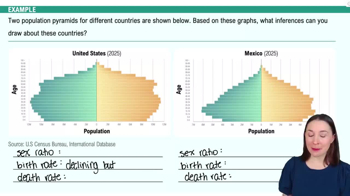
 02:24
02:24