The crude birth rate is the number of live births per 1,000 people in the population per year.
How does the crude death rate differ from the crude birth rate?
The crude death rate is the number of deaths per 1,000 people in the population per year, while the crude birth rate measures live births.
What happens to a population if the fertility rate is higher than the mortality rate?
The population increases because more people are being born than are dying.
What does a population pyramid show?
A population pyramid graphically represents the age and sex composition of a population.
What does a pyramid-shaped population pyramid indicate about a country?
It indicates a high birth rate and high death rate, with many young people and fewer older individuals.
How does the population pyramid of a country with low birth and death rates typically look?
It often appears more rectangular, with a larger proportion of older individuals and fewer children.
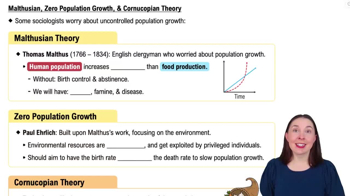
What is the main idea of Malthusian theory?
Malthusian theory argues that population grows faster than food production, leading to potential shortages and checks like war, famine, and disease.
How does zero population growth theory differ from Malthusian theory?
Zero population growth theory focuses on the balance between birth and death rates to stabilize population and emphasizes the limits of environmental resources, not just food.
What is the central belief of cornucopian theory?
Cornucopian theory believes that technological innovation will continue to meet human needs, viewing population growth as a driver of progress.
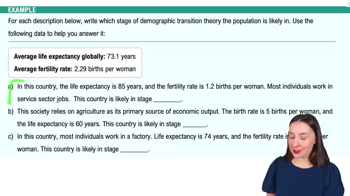
According to demographic transition theory, what characterizes stage one societies?
Stage one societies have high birth and death rates, resulting in a stable population size.
What technological stage is associated with rapid population growth in demographic transition theory?
Stage two, or early industrial societies, experience rapid population growth due to high birth rates and declining death rates.
What happens to birth and death rates in stage three of demographic transition theory?
In stage three, birth rates decline and death rates remain low, leading to slower population growth.
What is typical of stage four societies in demographic transition theory?
Stage four societies are post-industrial, with low birth and death rates, resulting in a stable population.
Why do children become less of an economic asset in later stages of demographic transition?
As societies industrialize, children become more expensive to raise and less economically beneficial to families.
How do population theories help us understand socio-environmental impacts?
They provide frameworks for analyzing how population growth and composition affect resource use, environmental sustainability, and societal development.
 Back
Back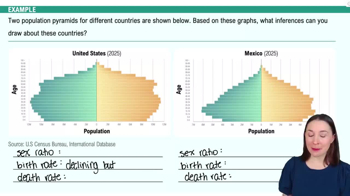
 02:24
02:24