Skip to main content
Introduction to Sociology
My Course
Learn
AI Tutor
Study Guides
Flashcards
Explore
Try the app
My Course
Learn
AI Tutor
Study Guides
Flashcards
Explore
Try the app
Back
Power & Authority definitions
You can tap to flip the card.
Power
You can tap to flip the card.
👆
Power
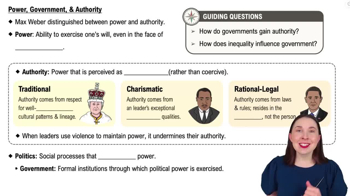
Ability to exercise one's will over others, even in the face of resistance, not necessarily requiring legitimacy.
Track progress
Control buttons has been changed to "navigation" mode.
1/14
Related flashcards
Recommended videos
Power & Authority quiz
Power & Authority
15 Terms
Guided course
00:49
Power & Authority Example 1
90
views
1
rank
Guided course
04:41
Power, Government, & Authority
109
views
1
rank
Terms in this set (14)
Hide definitions
Power
Ability to exercise one's will over others, even in the face of resistance, not necessarily requiring legitimacy.
Authority
Form of power regarded as legitimate by those subject to it, distinguishing it from coercion or manipulation.
Traditional Authority
Legitimacy derived from established cultural patterns or lineage, often seen in monarchies.
Charismatic Authority
Legitimacy based on a leader's exceptional personal qualities, often emerging during social upheaval.
Rational-Legal Authority
Legitimacy rooted in laws and rules, with authority residing in the position rather than the individual.
Legitimacy
Widespread recognition that power or authority is appropriate and justified within a society.
Coercion
Use of force or threats to obtain compliance, undermining the perception of legitimate authority.
Manipulation
Influence exerted through deceptive or indirect means, often associated with illegitimate power.
Politics
Social processes that regulate how power is acquired, distributed, and exercised at various levels.
Government
Formal institutions responsible for creating, maintaining, and enforcing laws within a society.
Bureaucracy
Organizational structure characterized by rules, roles, and procedures, central to rational-legal authority.
Monarchy
System of governance where authority is inherited, typically justified by tradition and cultural norms.
Social Stratification
Hierarchical arrangement of individuals or groups in society, often influenced by power and authority.
Inequality
Unequal distribution of resources, opportunities, or power, shaped and reinforced by political systems.
 BackBack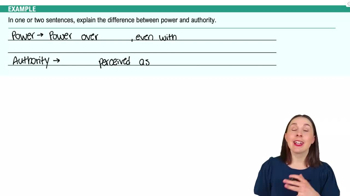
 00:49
00:49