Skip to main content
Introduction to Sociology
My Course
Learn
AI Tutor
Study Guides
Flashcards
Explore
Try the app
My Course
Learn
AI Tutor
Study Guides
Flashcards
Explore
Try the app
Back
Power & Authority quiz
You can tap to flip the card.
How did Max Weber distinguish between power and authority?
You can tap to flip the card.
👆
How did Max Weber distinguish between power and authority?
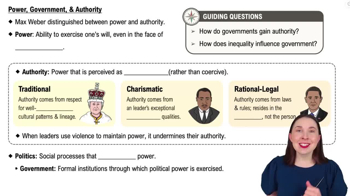
Weber defined power as the ability to exercise one's will even in the face of resistance, while authority is power that is perceived as legitimate.
Track progress
Control buttons has been changed to "navigation" mode.
1/15
Related flashcards
Recommended videos
Power & Authority definitions
Power & Authority
14 Terms
Guided course
00:49
Power & Authority Example 1
90
views
1
rank
Guided course
04:41
Power, Government, & Authority
109
views
1
rank
Terms in this set (15)
Hide definitions
How did Max Weber distinguish between power and authority?
Weber defined power as the ability to exercise one's will even in the face of resistance, while authority is power that is perceived as legitimate.
What is traditional authority based on according to Weber?
Traditional authority is based on respect for well-established cultural patterns or lineage, such as monarchies.
How does charismatic authority differ from traditional authority?
Charismatic authority stems from a leader's exceptional personal qualities, while traditional authority relies on cultural norms and traditions.
What is rational-legal authority and where does its legitimacy come from?
Rational-legal authority is based on laws and rules, with legitimacy residing in the position rather than the person.
What happens to traditional authority as societies become more industrialized?
Traditional authority tends to decline as societies become more industrialized.
When do charismatic leaders often emerge?
Charismatic leaders often emerge during times of social upheaval or revolution.
Give an example of a charismatic leader and explain why.
Martin Luther King Jr. is considered a charismatic leader due to his exceptional personal qualities and influence.
How can violence affect a leader's authority?
Using violence to maintain power undermines a leader's authority, making it seem less legitimate.
What is the main difference between power and authority?
Power can be exercised through manipulation or coercion, while authority is legitimate power accepted by society.
What is politics in sociological terms?
Politics refers to the social processes that regulate power, including how it is acquired and exercised.
How is government defined in this chapter?
Government consists of formal institutions through which political power is exercised, including creating, maintaining, and enforcing laws.
Can politics exist outside of formal government institutions?
Yes, politics can exist at micro levels, such as office politics, wherever there are power dynamics.
What is the relationship between politics and government?
Politics is the process of regulating power, while government is the institution where political power is formally exercised.
Why is understanding the distinction between power and authority important?
It clarifies how political power operates within societies and helps analyze legitimacy, governance, and social order.
What impact does authority have on social stratification and inequality?
Authority influences social stratification and inequality by legitimizing certain power structures within society.
 BackBack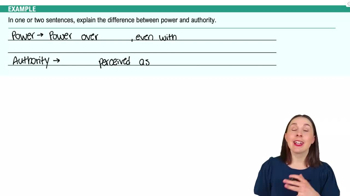
 00:49
00:49