Skip to main content
Introduction to Sociology
My Course
Learn
Exam Prep
AI Tutor
Study Guides
Flashcards
Explore
Try the app
My Course
Learn
Exam Prep
AI Tutor
Study Guides
Flashcards
Explore
Try the app
Back
Social Networks quiz
You can tap to flip the card.
What is a social network in sociology?
You can tap to flip the card.
👆
What is a social network in sociology?
A social network is a web of both direct and indirect social ties, or connections, between individuals.
Track progress
Control buttons has been changed to "navigation" mode.
1/15
Related flashcards
Related practice
Recommended videos
Social Networks definitions
Social Networks
15 Terms
Social Networks
6. Groups and Organizations
5 problems
Topic
Group Size and Structure
6. Groups and Organizations
5 problems
Topic
6. Groups and Organizations - Part 1 of 2
4 topics
12 problems
Chapter
6. Groups and Organizations - Part 2 of 2
2 topics
6 problems
Chapter
Guided course
02:10
Social Networks
137
views
Guided course
00:50
Social Networks Example 1
109
views
Terms in this set (15)
Hide definitions
What is a social network in sociology?
A social network is a web of both direct and indirect social ties, or connections, between individuals.
What distinguishes a direct social tie from an indirect social tie?
A direct social tie is someone you are in contact with, while an indirect tie is someone you know through another person.
What are strong social connections?
Strong social connections are people you interact with frequently, such as daily or weekly, and who provide emotional and social support.
How are weak social connections different from strong ones?
Weak social connections are people you interact with less often, such as every few months or years, and typically provide access to diverse resources.
Can social networks include people you have never met?
Yes, social networks can include indirect connections to people you have never met, often through mutual acquaintances.
What types of support can social networks provide?
Social networks can provide social support, access to resources, information, and career advancement opportunities.
How can indirect connections in a social network benefit you?
Indirect connections can give you access to resources like job references, services, or information through people you know.
What is an example of a resource accessed through an indirect social tie?
An example is getting a plumber or realtor through a friend of a friend, or a job reference from someone you have never met.
Why are strong ties important in a social network?
Strong ties are important because they provide the most emotional and social support.
Why are weak ties valuable in a social network?
Weak ties are valuable because they expand access to diverse resources and opportunities beyond your immediate circle.
How do social networks relate to social mobility?
Social networks can shape individual opportunities and social mobility by connecting people to resources and information.
What role do social networks play in social stratification?
Social networks influence social stratification by affecting the distribution of social capital and access to opportunities.
How do social networks connect social groups and institutions?
Social networks illustrate how social groups and institutions interconnect, impacting individual and group access to resources.
What is social capital in the context of social networks?
Social capital refers to the resources and benefits gained from social connections within a network.
How expansive are most people's social networks?
Most people's social networks are more expansive than they realize, including many indirect connections.
 BackBack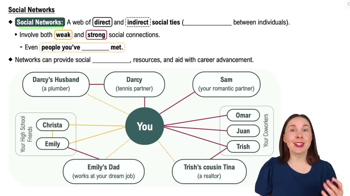
 02:10
02:10