 Back
Introduction to Sociology - Key Concepts and Theories
 03:30

Terms in this set (29)
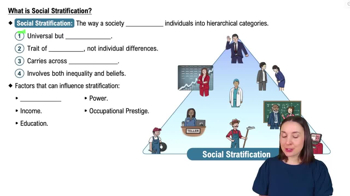
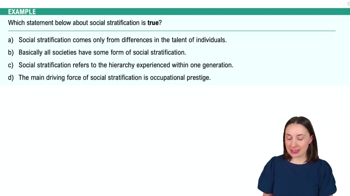
Social stratification is the distance between people at the "top" and those at the "bottom" of a society, reflecting structured inequality.
Karl Marx emphasized the class struggle between the bourgeoisie (factory owners) and the proletariat (workers) as the core conflict in capitalism.
Capitalism is characterized by private ownership of production, while socialism advocates collective or public ownership, aiming to replace capitalism.
Class relations are relational and naturally coercive, involving exploitation and oppression between classes.
Dominant ideologies reflect the interests of the dominant class and make it difficult for oppressed groups to unite against exploitation.
SES is a composite measure including income, education, and occupational prestige, used to assess social standing.
Wealth is the total assets owned, while income is earnings over time; wealth inequality is generally greater than income inequality.
Intergenerational mobility occurs across generations; intragenerational mobility happens within a single generation.
Relative poverty is deprivation compared to others; absolute poverty is lacking basic resources below a fixed threshold.
The Gini Coefficient is a scale from 0 to 1 measuring inequality within a population; 0 means perfect equality, 1 means maximum inequality.
Race is not biological but a social construct created through social interactions and cultural meanings.
Ethnicity is based on cultural differences, while race is a social classification often linked to perceived physical traits.
Racism is ordinary, serves important purposes, is socially constructed, and intersectionality is crucial to understanding race.
Prejudice is an attitude or feeling toward a group; discrimination is acting differently based on group membership.
Contact theory suggests that cooperation and interaction between groups can reduce prejudice and increase tolerance.
W.E.B. Du Bois's concept describing the internal conflict experienced by subordinated groups in an oppressive society.
Sex is biological identity based on chromosomes; gender is a social and cultural concept of masculinity and femininity.
Gender is sustained through repeated social performances and behaviors, as explained by Goffman's dramaturgical perspective.
First wave focused on legal equality, second on workplace and reproductive rights, third on inclusivity and cultural critique.
Coined by Kimberlé Crenshaw, intersectionality examines how multiple dimensions of inequality intersect and affect individuals.
Sexuality encompasses feelings, attractions, and behaviors; sexual orientation refers to who one is attracted to.
Negative attitudes toward LGBTQ+ individuals are declining, influenced by factors like education, urban living, and personal connections.
Language shapes thought and perception, influencing how people understand the world.
Mass media transmits information widely and acts as a socializing agent shaping norms and values.
The digital divide refers to inequalities in access to technology and the internet within and between countries.
Alternative media are non-corporate, anti-establishment, creatively distributed, and encourage interactive producer-consumer relationships.
A family is a group related by blood, marriage, or cohabitation, functioning as a social unit.
Marriage is less institutionalized today, with more focus on personal fulfillment and diverse family forms.
Different sociological theories offer varied perspectives on family roles, structures, and changes over time.