 Back
BackNationalism, Exclusion, and Citizenship: Sociological Perspectives
Study Guide - Smart Notes
 Tailored notes based on your materials, expanded with key definitions, examples, and context.
Nationalism and Exclusion
Definition and Nature of Nationalism
Nationalism is a political ideology that positions the nation as the primary unit of collective identity and political organization. It is often defined by shared cultural (language, religion, history) and/or political characteristics (territorial community, citizenship). Nationalism can be both inclusionary and exclusionary, depending on its form and context.
Exclusionary Aspects: Nationalism often distinguishes between 'us' and 'them,' leading to the marginalization or exclusion of those considered outside the national group.
Subjectivity: The concept of nation is subjective, shaped by group identities and their perceptions of culture and belonging.
Heywood's View: Nationalism is an ideology that makes the nation the central pillar of political organization, but its goals and definitions vary.
Types of Nationalism
Cultural (Ethnic) Nationalism: Membership is based on inherited ethnic identity (e.g., Xhosa, Sotho), often leading to exclusion of other groups.
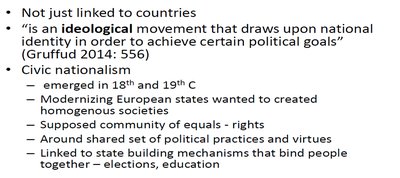
Political (Civic) Nationalism: Focuses on shared citizenship, civic values, and the idea of an 'imagined community.' It is rooted in liberal ideals such as freedom, equality, and individual rights, and is less tied to ethnicity.
Example: The United States and France are often cited as examples of civic nationalism, where national identity is based on shared political values rather than ethnic background.
National Identity, Borders, and Exclusion
National identity is constructed through shared symbols, language, and history, but also through the drawing of borders—both physical and symbolic—that separate insiders from outsiders. This process can reinforce exclusion based on ethnicity, gender, or other social categories.
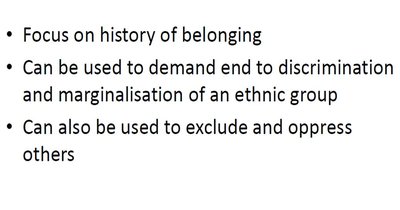
History of Belonging: Nationalism often draws on a sense of historical belonging to a particular land or community.
Dual Role: Nationalism can be used to demand rights for marginalized groups, but also to exclude or oppress others.
Relationship Between Nationalism and Land
Nationalism frequently links a specific group of people to a particular territory, reinforcing the idea of a 'homeland.' This association can be seen in the nationalization of nature, where landscapes become symbols of the nation.
Homeland: The concept of a homeland is central to many nationalist ideologies.
Historic Sites: Certain landscapes and sites are imbued with national significance.
Renationalization: The process of returning assets or industries to state ownership can be part of nationalist projects.
Nationalism, Economic Hardship, and Social Divisions
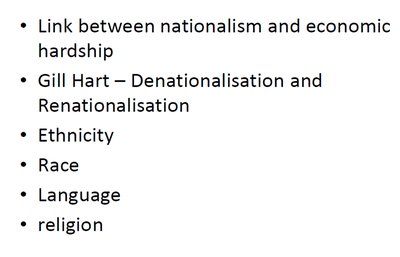
Economic hardship can intensify nationalist sentiments, often leading to the scapegoating of outsiders. Nationalism intersects with ethnicity, race, language, and religion, shaping who is included or excluded from the national community.
Denationalization and Renationalization: Processes described by Gill Hart, referring to the shifting boundaries of national control and identity.
Social Divisions: Nationalism can reinforce divisions based on ethnicity, race, language, and religion.
Civic Nationalism and the Imagined Community
Origins and Features of Civic Nationalism
Civic nationalism emerged in the 18th and 19th centuries as European states sought to create homogenous societies based on shared political values and rights. It is characterized by:
Community of Equals: Emphasis on equal rights and participation.
State-Building Mechanisms: Institutions such as elections and education bind people together.
Shared Practices and Virtues: National identity is constructed around common political practices.
Benedict Anderson's 'Imagined Community': Anderson argues that nations are 'imagined communities' because members will never know most of their fellow-members, yet they share a sense of communion.
Xenophobia and Exclusion
Causes of Xenophobic Violence (Landau)
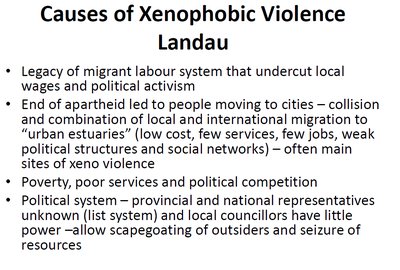
Xenophobia refers to the fear or hatred of foreigners or strangers. In the South African context, several factors contribute to xenophobic violence:
Legacy of Migrant Labour: Systems that undercut local wages and political activism.
Urban Migration: Post-apartheid migration to cities creates competition for scarce resources and weakens social networks.
Poverty and Competition: Economic hardship and poor services fuel resentment and competition.
Political System: Weak local representation allows for scapegoating of outsiders and seizure of resources.
Citizenship and Belonging
Evolution of Citizenship
Citizenship has evolved from local rights and freedoms to national institutions, influenced by the rise of capitalism, liberalism, and modernity. It now encompasses civil, political, and social rights, including welfare provisions.
Local to National: Shift from village-based rights to national citizenship guaranteed by the state.
Welfare State: Modern citizenship includes entitlements such as health, housing, and education.
Contested Concept: Citizenship is multifaceted and changes with culture, history, and circumstances.
Changing Nature of Citizenship
Globalization and new forms of mobility have transformed the meaning of citizenship. Borders are less significant, and new types of citizenship have emerged:
Denizenship: Legal residents without full citizenship rights.
Flexible Citizenship: Individuals hold multiple citizenships and use them strategically for rights and freedoms.
Cosmopolitan/Global Citizenship: Identification with global rather than national communities.
Nomad and Prosthetic Citizenship: Forms of belonging that are mobile, networked, or constructed through technology.
Politics of Belonging
Belonging is a complex, multi-dimensional process involving social locations (class, gender, race), emotional attachments (identity), and ethical/political values. It is not fixed to a single territory and can be multiple, hybrid, or contested.
Multiple Allegiances: Individuals can belong to several communities simultaneously.
Role of the State: Despite new forms of belonging, the state remains a central reference point.
Building Solidarities: New forms of solidarity are needed to address the challenges of diversity and migration.
Summary and Conclusion
Nationalism is a contested and evolving concept, shaped by cultural, political, and economic factors. It can foster both inclusion and exclusion, depending on how national identity is constructed and practiced. Citizenship and belonging are similarly dynamic, influenced by globalization, migration, and changing social values. Understanding these processes is essential for analyzing contemporary issues of identity, exclusion, and social cohesion.
