 Back
News Media, Victims, and Crime: Sociological Perspectives on Media Representations of Victimhood
Study Guide - Smart Notes
 Tailored notes based on your materials, expanded with key definitions, examples, and context.
News Media, Victims, and Crime
Introduction
This chapter explores how the news media construct and define the status of crime victims, focusing on the sociological influences of class, race, ethnicity, gender, age, and sexuality. It critically examines the selective nature of media coverage, the concept of 'ideal victims,' and the impact of media representations on criminal justice policy and public perception.
News Media Constructions of 'Ideal', Primary, and Indirect Victims
Ideal Victims
The media are most interested in crime victims who fit the 'ideal victim' profile. According to Christie (1986), an ideal victim is someone perceived as vulnerable, innocent, and deserving of sympathy—such as elderly women or young children. In contrast, individuals on the social margins (e.g., young men, the homeless, drug users) struggle to achieve legitimate victim status.
Hierarchy of Victimisation: Media and official discourses reinforce a hierarchy, where 'ideal victims' receive extensive coverage and sympathy, while 'undeserving victims' are often ignored.
Demographic Influences: Class, gender, and race significantly affect media attention. Middle-class, photogenic children (e.g., Holly Wells and Jessica Chapman) receive more coverage than working-class or minority victims.
Example: The disappearance of Holly Wells and Jessica Chapman attracted international attention, while similar cases involving working-class boys received little coverage.
Primary and Indirect Victims
Primary victims are those directly harmed by crime, while indirect victims include family, friends, and the wider community affected by the event. Media legitimacy for primary victims is based on their characteristics and context; indirect victims' status depends on their association with the primary victim and their engagement with the media.
Media Engagement: Indirect victims who actively engage with the media (e.g., holding press conferences) can maintain public sympathy and media attention.
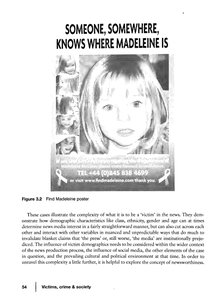
Example: Madeleine McCann's parents initially received support as indirect victims but later became suspects due to media speculation.
Newsworthiness, Crime, and Criminal Victimisation
Factors Influencing Newsworthiness
Newsworthiness is determined by news values—criteria such as drama, novelty, violence, and conservative ideology. Violence, especially murder, is a core news value, elevating crimes to media visibility.
Cultural Specificity: News values reflect the historical and social context. Changes in society, such as the rise of celebrity culture and sexualisation, influence what is considered newsworthy.
Paradigmatic Cases: High-profile incidents (e.g., Stephen Lawrence, Sarah Payne, Jimmy Savile) shape ongoing media coverage and public debates about crime, race, and institutional failure.
Newsworthiness, Crime Victims, and the Visual
The Role of Visuals in Crime Reporting
Visual elements, such as photographs and press conferences, have become central to crime news production. The ability to visualise a case increases its newsworthiness and emotional impact.
Victim Photographs: Images of victims humanise and memorialise them, creating strong affective connections with audiences.
Media Engagement: Families who provide photographs and participate in press conferences help sustain media attention.
Example: Iconic images, such as Holly Wells and Jessica Chapman in matching shirts, became lasting reference points in public memory.

Crime Victims and Institutional Failure
Institutional Blame and Media Campaigns
Media narratives often attribute blame not only to offenders but also to institutions that fail to protect victims. Evidence of institutional failure increases the symbolic power of victims and sustains media interest.
Official Inquiries: High-profile cases led to inquiries and policy changes, such as the Macpherson Report (Stephen Lawrence), Sarah's Law (Sarah Payne), and the Bichard Inquiry (Holly Wells and Jessica Chapman).
Collective Moral Outrage: Media campaigns in victims' names can drive public support and policy reform.
Example: The Savile scandal resulted in the Independent Inquiry into Child Sexual Abuse (ICSA), addressing widespread institutional abuse.
Summary and Further Questions
Key Points
Media constructions of crime victims are shaped by social divisions and inequalities.
Ideal victim status is selectively attributed, influencing media coverage and public sympathy.
Visuals and media engagement play crucial roles in sustaining attention and shaping narratives.
Institutional failures amplify the symbolic power of victims and drive policy change.
Questions for Further Research
How do individuals and groups solicit and sustain media interest in crime victims?
What conditions make marginalised victims worthy of media attention?
How does selective representation impact crime consciousness?
What is the influence of social media on crime victim representation?
Further Reading
Chermak, S. (1995). Victims in the News: Crime and the American News Media.
Cottle, S. (2004). The Racist Murder of Stephen Lawrence: Media Performance and Public Transformation.
Greer, C. (2003/2012). Sex Crime and the Media: Sex Offending and the Press in a Divided Society.
Crime, Media Culture: An International Journal.
