 Back
BackPolitical Systems and Economic Theories: A Sociological Overview
Study Guide - Smart Notes
 Tailored notes based on your materials, expanded with key definitions, examples, and context.
Government and Politics
Types of Political Systems
Political systems are the formal and informal structures that organize, govern, and regulate societies. Understanding these systems is essential for analyzing how power and authority are distributed and exercised in different societies.
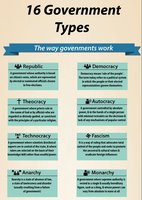
Democracy: A system where power is vested in the people, who rule either directly or through freely elected representatives.
Republic: A form of government in which the country is considered a "public matter" and officials are elected as representatives of the people.
Monarchy: A government ruled by a king, queen, or emperor, where power is usually inherited.
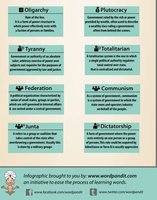
Oligarchy: A system where a small group of people hold power.
Theocracy: A government controlled by religious leaders or based on religious law.
Autocracy: A system where one person holds absolute power.
Technocracy: Government or control by technical experts.
Fascism: A form of far-right, authoritarian ultranationalism characterized by dictatorial power and strong regimentation of society and the economy.
Anarchy: Absence of government and absolute freedom of the individual.
Plutocracy: Government by the wealthy.
Tyranny: Cruel and oppressive government or rule.
Totalitarianism: Centralized control by an autocratic authority.
Federation: A union of partially self-governing states or regions under a central government.
Communism: A system where all property is publicly owned and each person works and is paid according to their abilities and needs.
Junta: A military or political group that rules a country after taking power by force.
Dictatorship: Government by a dictator with absolute authority.
Examples of Political Systems
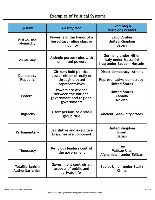
Political systems can be compared based on their leadership structure, source of authority, and citizen participation. The following table summarizes key differences among major systems:
System | Leadership | Citizen Participation |
|---|---|---|
Democracy | Elected officials | High (voting, civil liberties) |
Monarchy | Hereditary ruler | Low (citizens have limited power) |
Dictatorship | Single leader | Very low (power concentrated) |
Theocracy | Religious leaders | Varies (based on religious law) |
Republics and Democracies
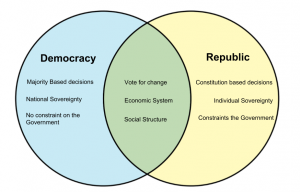
Republics and democracies are often discussed together, but they have distinct characteristics. A republic is a state in which power rests with the people and their elected representatives, and which has an elected or nominated president rather than a monarch. A democracy emphasizes majority rule and the protection of individual rights.
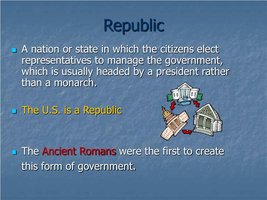
Republic: Citizens elect representatives to manage the government. The U.S. is an example of a republic. The concept originated with the Ancient Romans.
Democracy: Focuses on majority-based decisions and national sovereignty, with fewer constraints on government actions.
Work and Economy
Economic Theories: Marxism, Communism, Socialism, and Capitalism
Economic systems are closely linked to political systems and influence the distribution of resources, power, and social relations. The following theories are foundational in sociology:
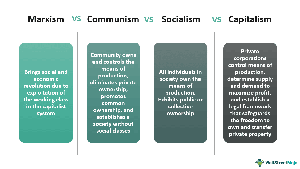
Marxism: A social, political, and economic theory originating from Karl Marx, focusing on class struggle and the need for a revolution to overthrow capitalist systems.
Communism: Advocates for communal ownership of the means of production, with the goal of achieving a classless society.
Socialism: All individuals in society share ownership of the means of production, with public or worker ownership emphasized.
Capitalism: Private individuals or corporations control the means of production, and the economy is driven by supply and demand in a free market.
Comparison Table:
Theory | Ownership of Means of Production | Key Features |
|---|---|---|
Marxism | Class struggle; aims for communal ownership | Revolutionary change, critique of capitalism |
Communism | Community/state | Classless society, abolition of private property |
Socialism | Society/public | Collective ownership, redistribution of wealth |
Capitalism | Private individuals/corporations | Market competition, private property |
Example: In a capitalist society, businesses are privately owned and operate for profit, while in a socialist society, key industries may be owned by the state or cooperatives to ensure equitable distribution of resources.
Additional info: These political and economic systems are foundational for understanding social stratification, power dynamics, and the organization of societies in sociology.
