Addition Rule quiz #1 Flashcards

Addition Rule quiz #1
Control buttons has been changed to "navigation" mode.
1/10
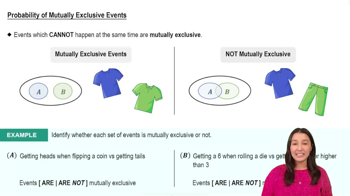
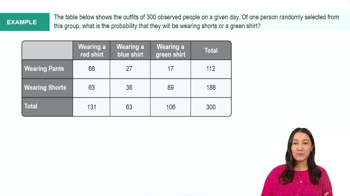
  • Which types of probability calculations require the use of the addition rule, and how is the rule applied for mutually exclusive and non-mutually exclusive events?
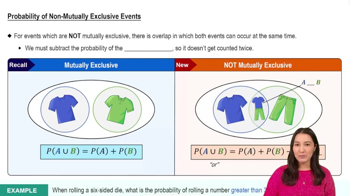
    The addition rule is used when calculating the probability of the union of two events, that is, the probability that event A or event B occurs (P(A or B)). For mutually exclusive events (which cannot occur at the same time), the rule is: P(A or B) = P(A) + P(B). For non-mutually exclusive events (which can occur together), the rule is: P(A or B) = P(A) + P(B) - P(A and B), where P(A and B) is subtracted to avoid double-counting the overlap.
  • What does the region of overlap in a circle diagram represent when analyzing two events?
    The region of overlap represents outcomes where both events occur simultaneously. This is relevant for non-mutually exclusive events.
  • How is the probability of rolling a 3 or a 5 on a six-sided die calculated?
    Add the probability of rolling a 3 to the probability of rolling a 5. The result is 2/6, which simplifies to 1/3 or 0.33.
  • Why must you subtract the probability of the overlap when calculating the probability of non-mutually exclusive events?
    Subtracting the overlap prevents double-counting outcomes that satisfy both events. This ensures the probability calculation is accurate.
  • What symbol is used in set notation to represent 'or' between two events?
    The 'or' between two events is represented by the union symbol, which looks like a 'U'. It indicates the probability of either event occurring.
  • In the example of rolling a die, which numbers are included in the overlap when considering 'greater than 3' and 'even'?
    The numbers 4 and 6 are included in the overlap because they are both greater than 3 and even. These outcomes must be subtracted when using the addition rule for non-mutually exclusive events.
  • How does the general addition rule formula simplify for mutually exclusive events?
    For mutually exclusive events, the probability of both events occurring together is zero. Therefore, the formula simplifies to just adding the individual probabilities.
  • What is the decimal equivalent of the probability of rolling a 3 or a 5 on a six-sided die?
    The decimal equivalent is approximately 0.33. This is found by dividing 1 by 3.
  • What is the probability of rolling a number greater than 3 or an even number on a six-sided die?
    The probability is 4/6, which simplifies to 2/3 or 0.67. This accounts for the overlap between the two events.
  • How does the addition rule apply to events like getting heads or tails when flipping a coin?
    Since heads and tails are mutually exclusive, their probabilities are simply added. The probability of getting heads or tails is 1.