How is a Pareto chart different from a standard vertical bar graph?
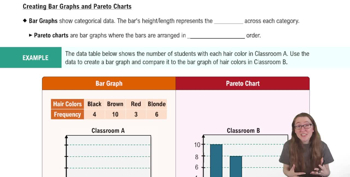
A Pareto chart is a special type of bar graph where the bars are arranged in descending order of frequency, making it easier to identify the most and least common categories. In contrast, a standard vertical bar graph may display categories in any order.
What is the primary purpose of bar graphs in statistics?
Bar graphs are used to display and compare categorical data by representing the frequency of each category with the height or length of bars.
How does a Pareto chart enhance readability compared to a standard bar graph?
A Pareto chart enhances readability by arranging the bars from tallest to shortest, allowing viewers to quickly identify the most and least frequent categories.
What is the main use of a Pareto chart in data visualization?
The main use of a Pareto chart is to highlight the most significant categories by displaying frequencies in descending order, making it easier to identify major trends or issues.
In what way does the arrangement of bars in a Pareto chart differ from that in a standard bar graph?
In a Pareto chart, bars are arranged in descending order of frequency, whereas in a standard bar graph, categories may be arranged in any order.
What distinguishes a Pareto chart from a regular vertical bar graph?
A Pareto chart is distinguished by its arrangement of bars in descending order of frequency, while a regular vertical bar graph does not require any specific order.
How does the order of bars in a Pareto chart differ from a standard bar graph?
The bars in a Pareto chart are ordered from highest to lowest frequency, whereas a standard bar graph may have bars in any order.
Bar graphs compare values across categories using what feature to display their information?
Bar graphs use the height or length of bars to display and compare the frequency of values across categories.
Is a Pareto chart the same as a histogram chart?
No, a Pareto chart is not the same as a histogram. A Pareto chart is a bar graph for categorical data arranged in descending order, while a histogram displays the distribution of numerical data across intervals.
Why is it important to choose an appropriate scale for the y-axis when creating a bar graph?
An appropriate y-axis scale ensures that all data points, from the minimum to the maximum frequency, are accurately represented. This allows for clear comparison of bar heights and prevents misinterpretation of the data.