What are the necessary conditions to perform a chi-square goodness-of-fit test?
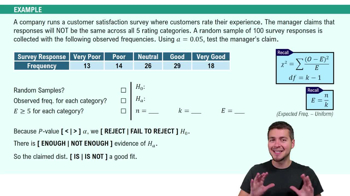
The necessary conditions are: (1) data are from a random sample, (2) observed frequencies are available for all categories, and (3) expected frequencies for each category are at least 5.
For what type of data is a chi-square goodness-of-fit test most appropriate?
A chi-square goodness-of-fit test is most appropriate for categorical data where you want to compare observed frequencies to expected frequencies based on a claimed distribution.
How is the chi-square test statistic for a goodness-of-fit test calculated?
The chi-square test statistic is calculated as χ² = Σ[(O - E)² / E], where O is the observed frequency and E is the expected frequency for each category.
What are the possible values for a chi-square statistic?
A chi-square statistic can take any value greater than or equal to zero; it cannot be negative.
How would you describe the purpose of the chi-square test for goodness of fit?
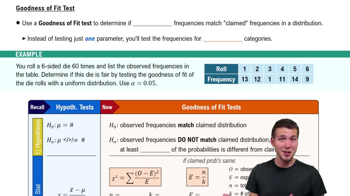
The chi-square test for goodness of fit is used to determine whether observed frequencies differ significantly from expected frequencies based on a claimed distribution.
What does the null hypothesis specify in a chi-square goodness-of-fit test?
The null hypothesis specifies that the observed frequencies match the expected frequencies according to the claimed distribution.
What is not true about the chi-square goodness-of-fit test?
It is not true that the chi-square goodness-of-fit test can be used for data with expected frequencies less than 5 in any category.
What is the main use of the chi-square goodness-of-fit test?
The main use is to test whether observed categorical data fit a specified theoretical distribution.
What is not a characteristic of the chi-square distribution?
The chi-square distribution is not symmetric; it is skewed to the right, especially for small degrees of freedom.
What is not a requirement to conduct a chi-square goodness-of-fit test?
It is not required that the data be numerical or continuous; the test is for categorical data.
What is a key property of the chi-square distribution regarding its shape?
The chi-square distribution is always non-negative and is skewed to the right, becoming more symmetric as degrees of freedom increase.
What is a requirement for the expected frequencies in a chi-square goodness-of-fit test?
Each expected frequency must be at least 5.
What is the general process for conducting a chi-square goodness-of-fit test?
State the hypotheses, check conditions, calculate expected frequencies, compute the chi-square statistic, determine the p-value, and draw a conclusion.
How do you find the expected value for each category in a chi-square goodness-of-fit test when the claimed probabilities are equal?
Divide the total sample size by the number of categories: E = n / k.
How do you find the expected value for each category in a chi-square goodness-of-fit test when the claimed probabilities are not equal?
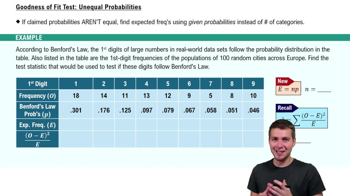
Multiply the total sample size by the claimed probability for each category: E = n × p (where p is the claimed probability for that category).
What is the formula for degrees of freedom in a chi-square goodness-of-fit test?
Degrees of freedom = number of categories minus one (df = k - 1).
How is the null hypothesis typically stated in a chi-square goodness-of-fit test?
The null hypothesis states that the observed frequencies follow the specified distribution.
What happens if the p-value in a chi-square goodness-of-fit test is less than the significance level?
If the p-value is less than the significance level, you reject the null hypothesis, indicating the observed data do not fit the claimed distribution.
What does a large chi-square statistic indicate in a goodness-of-fit test?
A large chi-square statistic indicates a large discrepancy between observed and expected frequencies, suggesting the data do not fit the claimed distribution well.
List the requirements to perform a chi-square goodness-of-fit test.
The requirements are: (1) data from a random sample, (2) all expected frequencies are at least 5, and (3) observed frequencies are available for all categories.
 Back
Back
 05:24
05:24