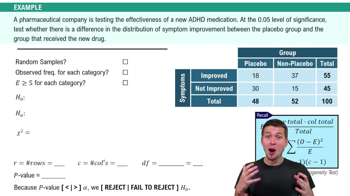
What is the main purpose of a homogeneity test in statistics?
A homogeneity test assesses whether the proportions of a characteristic are the same across different populations.
How does the null hypothesis for a homogeneity test differ from that of an independence test?
The null hypothesis for a homogeneity test states that the proportions are the same across populations, while for an independence test, it states that the variables are independent.
What is the alternative hypothesis in a homogeneity test?
The alternative hypothesis is that at least one population has a different proportion of the characteristic being studied.
What statistical test is used to analyze homogeneity?
The chi-square test is used to analyze homogeneity.
How is the chi-square statistic calculated in a homogeneity test?
It is calculated as the sum of (O - E)^2 / E for all cells, where O is observed frequency and E is expected frequency.
What does a small p-value indicate in a homogeneity test?
A small p-value indicates a significant difference in proportions, leading to rejection of the null hypothesis.
What are the requirements for using a homogeneity test?
You need random samples, observed frequencies for all categories, and expected frequencies greater than five for each category.
How are the steps for a homogeneity test similar to those for an independence test?
The calculation steps and math are exactly the same for both tests; only the hypotheses and conclusions differ.
What is the interpretation of rejecting the null hypothesis in a homogeneity test?
It means there is enough evidence to suggest that the proportions are different for at least one population.
How do you determine the degrees of freedom for a homogeneity test?
Degrees of freedom are calculated as (number of rows - 1) × (number of columns - 1).
What does the expected frequency represent in a homogeneity test?
The expected frequency is the value you would expect in each cell if the null hypothesis were true.
If you have a 2x2 contingency table, what is the degrees of freedom for the chi-square test?
The degrees of freedom would be 1, calculated as (2-1) × (2-1).
What conclusion do you draw if the p-value is less than alpha in a homogeneity test?
You reject the null hypothesis, concluding that not all proportions are equal across populations.
Why is it easy to confuse homogeneity tests with independence tests?
Because they use the same calculations and data tables, but their hypotheses and interpretations differ.
What must you check about expected frequencies before performing a homogeneity test?
You must ensure that all expected frequencies are greater than five.
 Back
Back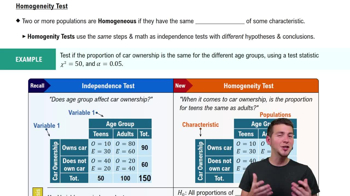
 05:27
05:27