Skip to main content
Introductory Statistics
My Course
Learn
Exam Prep
AI Tutor
Study Guides
Textbook Solutions
Flashcards
Explore
Try the app
My Course
Learn
Exam Prep
AI Tutor
Study Guides
Textbook Solutions
Flashcards
Explore
Try the app
Back
Fundamental Counting Principle quiz
You can tap to flip the card.
What does the fundamental counting principle allow you to do when faced with multiple options for different items?
You can tap to flip the card.
👆
What does the fundamental counting principle allow you to do when faced with multiple options for different items?
It allows you to find the total number of possible outcomes by multiplying the number of choices for each item.
Track progress
Control buttons has been changed to "navigation" mode.
1/15
Related flashcards
Related practice
Recommended videos
Fundamental Counting Principle definitions
Fundamental Counting Principle
15 Terms
Fundamental Counting Principle
4. Probability
6 problems
Topic
Ernest
Counting
4. Probability
6 problems
Topic
Ernest
4. Probability - Part 1 of 3
3 topics
9 problems
Chapter
Ernest
4. Probability - Part 2 of 3
4 topics
12 problems
Chapter
Ernest
4. Probability - Part 3 of 3
2 topics
6 problems
Chapter
Ally
Guided course
04:04
Fundamental Counting Principle
3652
views
65
rank
Terms in this set (15)
Hide definitions
What does the fundamental counting principle allow you to do when faced with multiple options for different items?
It allows you to find the total number of possible outcomes by multiplying the number of choices for each item.
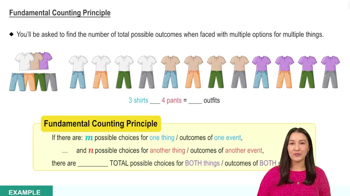
How many possible outfits can you make with 3 shirts and 4 pairs of pants?
You can make 12 possible outfits by multiplying 3 shirts by 4 pairs of pants (3 × 4 = 12).
What is the formula for the fundamental counting principle when you have m choices for one thing and n choices for another?
The formula is m × n, where you multiply the number of choices for each item.
How many different meals can you create from 4 appetizers and 6 entrees?
You can create 24 different meals by multiplying 4 appetizers by 6 entrees (4 × 6 = 24).
Does the fundamental counting principle apply only to choices, or can it also apply to outcomes of events?
It applies to both choices and outcomes of events, such as flipping a coin or rolling a die.
How many possible outcomes are there if you flip a coin and then roll a 6-sided die?
There are 12 possible outcomes (2 for the coin × 6 for the die = 12).
What are the possible outcomes when flipping a coin?
The possible outcomes are heads or tails, so there are 2 outcomes.
How many possible outcomes are there when rolling a 6-sided die?
There are 6 possible outcomes, one for each side of the die.
How do you use the fundamental counting principle when there are more than two items or events?
You multiply the number of options for each item or event together to get the total number of outcomes.
How many different outfits can be made from 4 shirts, 5 pairs of pants, and 3 pairs of shoes?
You can make 60 different outfits (4 × 5 × 3 = 60).
What should you do if you have three or more items to choose from using the fundamental counting principle?
Continue multiplying the number of options for each item to find the total number of combinations.
Why is the fundamental counting principle useful in probability and combinatorics?
It efficiently calculates combinations without listing each outcome, making it essential for probability and combinatorics.
If a menu has 5 desserts and 3 drinks, how many possible dessert-drink combinations are there?
There are 15 possible combinations (5 × 3 = 15).
What is the main advantage of using the fundamental counting principle instead of listing all outcomes?
It saves time and effort by quickly calculating the total number of outcomes through multiplication.
Can the fundamental counting principle be used for both making choices and determining event outcomes?
Yes, it can be used for both making choices and determining possible outcomes of events.
 BackBack

 04:04
04:04