Skip to main content
Introductory Statistics
My Course
Learn
Exam Prep
AI Tutor
Study Guides
Textbook Solutions
Flashcards
Explore
Try the app
My Course
Learn
Exam Prep
AI Tutor
Study Guides
Textbook Solutions
Flashcards
Explore
Try the app
Back
Independence Tests - Excel quiz
You can tap to flip the card.
What is the null hypothesis in a chi-square test of independence?
You can tap to flip the card.
👆
What is the null hypothesis in a chi-square test of independence?
The null hypothesis states that the two categorical variables are independent.
Track progress
Control buttons has been changed to "navigation" mode.
1/15
Related flashcards
Related practice
Recommended videos
Independence Tests - Excel definitions
Independence Tests - Excel
15 Terms
13. Chi-Square Tests & Goodness of Fit
4 topics
5 problems
Chapter
Guided course
07:08
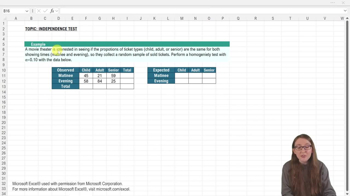
Independence Tests - Excel
158
views
2
rank
Guided course
06:38
Independence Tests - Excel Example 1
133
views
2
rank
Terms in this set (15)
Hide definitions
What is the null hypothesis in a chi-square test of independence?
The null hypothesis states that the two categorical variables are independent.
How do you calculate the expected frequency for a cell in a contingency table in Excel?
Multiply the row total by the column total and divide by the grand total.
Which Excel function is used to calculate the p-value for a chi-square test of independence?
The =CHISQ.TEST function is used to calculate the p-value.
What does it mean if the p-value is greater than the significance level (alpha) in an independence test?
It means you fail to reject the null hypothesis, indicating insufficient evidence to say the variables are dependent.
What is the purpose of organizing observed frequencies in a contingency table?
It helps structure the data for calculating totals, expected values, and performing the chi-square test.
How do you quickly calculate row or column totals in Excel?
Use the =SUM function to add the values in the desired row or column.
Why is it helpful to create a separate table for expected values in Excel?
It keeps expected values organized and makes it easier to reference them during calculations.
What should you avoid including when selecting the observed frequencies range for the =CHISQ.TEST function?
Do not include any row or column totals, only the observed frequencies.
What is the alternative hypothesis in a chi-square test of independence?
The alternative hypothesis states that the two variables are not independent (they are dependent).
What is the formula for the expected value in a contingency table cell?
Expected = (Row Total × Column Total) / Grand Total.
What does a p-value of 0.9 indicate if alpha is 0.05 in an independence test?
It indicates that you fail to reject the null hypothesis, so there is not enough evidence to say the variables are dependent.
Can the same steps for an independence test in Excel be used for a homogeneity test?
Yes, the calculations are the same; only the wording of hypotheses and conclusions differs.
What is the grand total in a contingency table?
The grand total is the sum of all observed frequencies in the table.
Why might expected values in a chi-square test be decimals?
Expected values are calculated mathematically and do not need to be whole numbers.
What is the first step before using the =CHISQ.TEST function in Excel?
Calculate all expected values and organize them in a table matching the observed frequencies.
 BackBack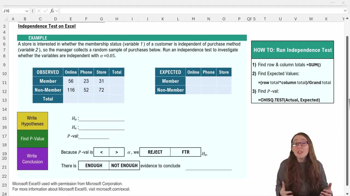
 07:08
07:08