Skip to main content
Introductory Statistics
My Course
Learn
Exam Prep
AI Tutor
Study Guides
Textbook Solutions
Flashcards
Explore
Try the app
My Course
Learn
Exam Prep
AI Tutor
Study Guides
Textbook Solutions
Flashcards
Explore
Try the app
Back
Introduction to ANOVA definitions
You can tap to flip the card.
ANOVA
You can tap to flip the card.
👆
ANOVA
A statistical method for comparing three or more group means by analyzing variance between and within groups.
Track progress
Control buttons has been changed to "navigation" mode.
1/15
Related flashcards
Related practice
Recommended videos
Introduction to ANOVA quiz #1
Introduction to ANOVA
10 Terms
Introduction to ANOVA
14. ANOVA
5 problems
Topic
Ally
14. ANOVA - Part 1 of 2
4 topics
12 problems
Chapter
Ally
14. ANOVA - Part 2 of 2
1 topic
3 problems
Chapter
Justin
Guided course
05:31
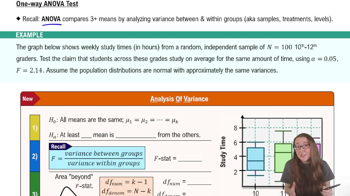
ANOVA Test
434
views
12
rank
Guided course
04:58
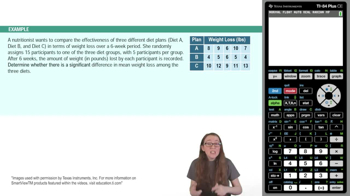
ANOVA Test Using TI-84
435
views
6
rank
1
comments
Guided course
02:43
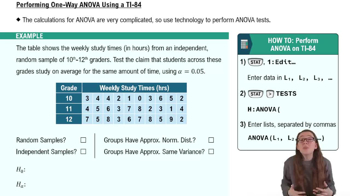
ANOVA Test Using TI-84 Example 1
336
views
3
rank
Terms in this set (15)
Hide definitions
ANOVA
A statistical method for comparing three or more group means by analyzing variance between and within groups.
Variance Between Groups
A measure of how far apart group data values are, indicating differences among group means.
Variance Within Groups
A measure of data spread within each group, reflecting how similar or diverse individual group values are.
F Statistic
A ratio of variance between groups to variance within groups, used to assess if group means differ.
Null Hypothesis
A statement asserting all group means are equal, forming the basis for statistical testing in ANOVA.
Alternative Hypothesis
A statement suggesting at least one group mean differs from the others, opposing the null hypothesis.
Degrees of Freedom
Numerical values used in ANOVA calculations, based on the number of groups and total observations.
P Value
A probability indicating the strength of evidence against the null hypothesis, compared to alpha.
Alpha
A threshold for statistical significance, commonly set at 0.05, guiding decision-making in hypothesis tests.
F Distribution
A probability distribution used in ANOVA for evaluating the F statistic and determining significance.
Random Sample
A selection method ensuring each member of the population has an equal chance of being chosen.
Independent Sample
A group where the selection or outcome of one member does not affect others, crucial for ANOVA validity.
Normal Distribution
A bell-shaped data pattern assumed for populations in ANOVA, supporting reliable statistical inference.
Equal Variances
A condition where group populations have similar variability, required for accurate ANOVA results.
Critical Value
A cutoff from statistical tables used to compare with the F statistic to decide on hypothesis rejection.
 BackBack
 05:31
05:31