Back

Introduction to Contingency Tables definitions

Control buttons has been changed to "navigation" mode.
1/14
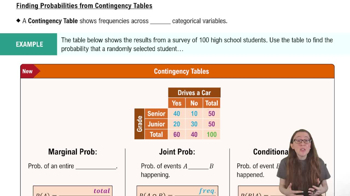
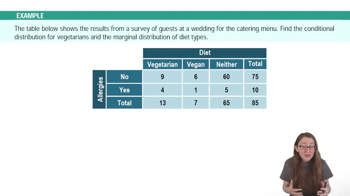
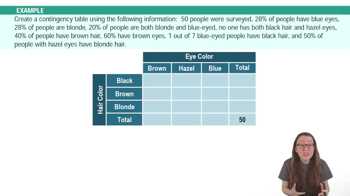
  • Contingency Table

    A grid summarizing frequencies for two categorical variables, with cells representing combinations of categories.
  • Categorical Variable

    A variable with distinct groups or categories, such as grade level or driving status, used in frequency analysis.
  • Frequency

    The count of responses or occurrences for a specific category or combination in a dataset.
  • Cell Frequency

    The value in a table cell indicating the number of cases for a particular pair of categories.
  • Row Total

    The sum of frequencies across all columns for a specific row, representing the total for one category.
  • Column Total

    The sum of frequencies across all rows for a specific column, representing the total for one category.
  • Grand Total

    The overall sum of all frequencies in a table, representing the total number of responses.
  • Marginal Probability

    The likelihood of a single category, calculated using the category total divided by the grand total.
  • Joint Probability

    The chance of two events occurring together, found by dividing a cell frequency by the grand total.
  • Conditional Probability

    The probability of one event occurring given another has already happened, using a cell frequency and a row or column total.
  • Intersection

    The point in a table where two categories meet, representing cases belonging to both.
  • Category Total

    The sum of frequencies for all cases within a single category, found in row or column totals.
  • Survey

    A method of collecting data from individuals, often used to gather categorical information for analysis.
  • Probability

    A measure of how likely an event or category is, expressed as a ratio or percentage based on table data.