Back

Multiplication Rule: Dependent Events definitions

Control buttons has been changed to "navigation" mode.
1/15
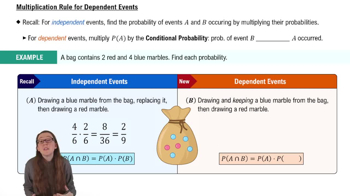
  • Dependent Events

    Situations where the outcome of one occurrence influences the likelihood of another happening.
  • Independent Events

    Occurrences where the result of one has no effect on the probability of the other.
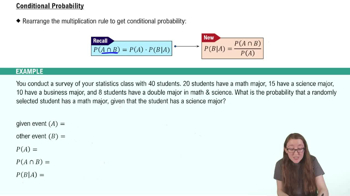
  • Conditional Probability

    Likelihood of an outcome, calculated under the assumption that another event has already occurred.
  • Multiplication Rule

    Method for finding the probability of two events by multiplying relevant probabilities, adjusted for dependence.
  • Probability Formula

    Expression used to compute the chance of combined events, often involving multiplication and conditional terms.
  • Survey

    Collection of data from a group, often used to determine probabilities in real-world scenarios.
  • Double Major

    Status of a student who fulfills requirements for two distinct academic fields simultaneously.
  • Numerator

    Top part of a fraction representing the count of favorable outcomes in probability calculations.
  • Denominator

    Bottom part of a fraction indicating the total number of possible outcomes in probability.
  • Vertical Line Notation

    Symbol used to denote conditional probability, read as 'given' between two events.
  • Real-World Application

    Use of probability concepts to solve practical problems outside academic settings.
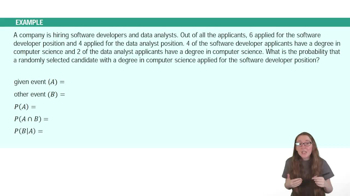
  • Event A

    The occurrence that is assumed or known to have happened when calculating conditional probabilities.
  • Event B

    The outcome whose probability is being determined, often dependent on another event.
  • Replacement

    Process of returning an item to its original set after selection, affecting event independence.
  • Without Replacement

    Selection method where chosen items are not returned, causing subsequent probabilities to change.