Back

Multiplication Rule: Dependent Events quiz

Control buttons has been changed to "navigation" mode.
1/15
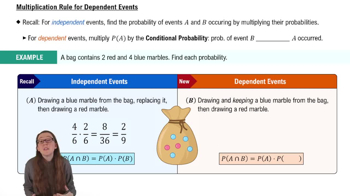
  • What is the formula for finding the probability of two dependent events A and B?

    The formula is P(A and B) = P(A) × P(B | A), where P(B | A) is the conditional probability of B given A.
  • How does the probability calculation differ between independent and dependent events?

    For independent events, you multiply the individual probabilities; for dependent events, you multiply the probability of the first event by the conditional probability of the second event given the first.
  • What does P(B | A) represent in probability?

    P(B | A) represents the probability that event B occurs given that event A has already occurred.
  • In the marble example, why does the probability change when you do not replace the first marble?

    The probability changes because the total number of marbles and the composition of colors in the bag are altered after the first draw, making the events dependent.
  • What is a conditional probability?

    A conditional probability is the probability of an event occurring given that another event has already occurred.
  • How do you write the conditional probability of B given A using probability notation?

    It is written as P(B | A), which is read as 'the probability of B given A.'
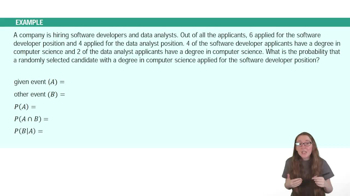
  • Why is it important to identify which event is A and which is B in conditional probability problems?

    Because the order matters: event A is the given event (the condition), and event B is the event whose probability you are finding given A.
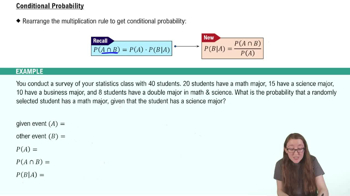
  • How do you find the probability that a student has a math major given they have a science major using survey data?

    Divide the number of students with both math and science majors by the number of students with a science major.
  • What is the probability that a student has a science major in a group of 40 students if 15 have a science major?

    The probability is 15/40.
  • If 8 out of 40 students have both a math and science major, what is P(math and science)?

    P(math and science) is 8/40.
  • How do you calculate P(math | science) from survey data?

    Divide P(math and science) by P(science), or (8/40) ÷ (15/40) = 8/15.
  • What clue in a word problem suggests you should use conditional probability?

    The word 'given' in the problem indicates you should use conditional probability.
  • Why might you rearrange the multiplication rule formula to solve for conditional probability?

    Because in many real-world problems, it's easier to find P(A and B) and P(A), and you often need to solve for P(B | A).
  • What is the conditional probability rule formula for P(B | A)?

    P(B | A) = P(A and B) / P(A).
  • Why do dependent events require the use of conditional probability?

    Because the outcome of the first event affects the probability of the second event, so you must account for the changed conditions.