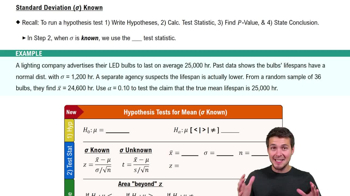
The t-test is principally a test of what statistical parameter?
The t-test is principally a test of the population mean when the population standard deviation is unknown.
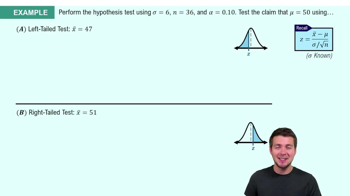
What does a left-tailed hypothesis test imply about the alternative hypothesis symbol?
A left-tailed test means the alternative hypothesis uses the less than symbol. This tests whether the population mean is less than a specified value.
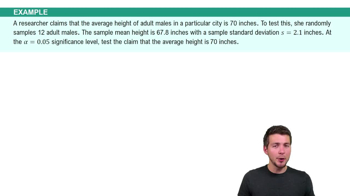
When performing a t-test, what value is used in the denominator of the test statistic formula?
The sample standard deviation (s) is used in the denominator for a t-test. This replaces the population standard deviation (σ) used in a z-test.
How do you determine the degrees of freedom for a t-test in hypothesis testing for means?
Degrees of freedom are calculated as the sample size minus one (n - 1). This value is needed to find the p-value using the t-distribution.
What is the decision rule when comparing the p-value to the significance level (alpha) in hypothesis testing?
If the p-value is less than alpha, you reject the null hypothesis. If the p-value is greater than alpha, you fail to reject the null hypothesis.
What are two key criteria that must be met before performing a hypothesis test for means?
You must have a random sample and either a normal distribution or a sample size greater than 30. These conditions ensure the validity of the test results.
Which calculator function should you use for a hypothesis test when the population standard deviation is known?
You should use the Z-Test function on the calculator when the population standard deviation is known. This applies the z-distribution to calculate the test statistic and p-value.
What information must be entered into a calculator when running a hypothesis test using summary statistics?
You need to enter the expected mean (from the null hypothesis), the standard deviation (sigma or s), the sample mean, and the sample size. These values allow the calculator to compute the test statistic and p-value.
How does the process differ when running a hypothesis test with raw data instead of summary statistics on a calculator?
With raw data, you input the data into a list and select the data option in the test menu. The calculator then computes the sample mean and standard deviation before running the test.
What does it mean if the p-value from a hypothesis test is very small compared to alpha?
A very small p-value indicates that the sample result is highly unlikely under the null hypothesis. This provides strong evidence to reject the null hypothesis in favor of the alternative.
 Back
Back
 05:55
05:55