Back

Sampling Distribution of Sample Proportion definitions

Control buttons has been changed to "navigation" mode.
1/15
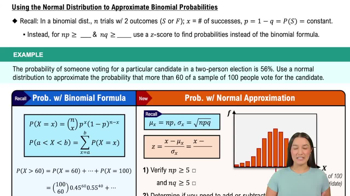
  • Binomial Distribution

    Probability model for discrete outcomes with fixed trials and two possible results, often used for success/failure scenarios.
  • Normal Distribution

    Bell-shaped curve used to approximate probabilities when sample size is large and certain conditions are met.
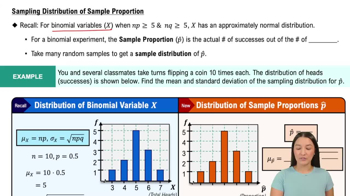
  • Sample Proportion

    Ratio of observed successes to total trials in a sample, providing a measure of relative frequency.
  • Sampling Distribution

    Graphical representation of a statistic's values from repeated random samples, showing its variability and shape.
  • Mean

    Expected value of a distribution, indicating the central tendency of observed outcomes.
  • Standard Deviation

    Measure of spread in a distribution, quantifying how much values typically differ from the mean.
  • Z Score

    Standardized value indicating how many standard deviations a data point is from the mean.
  • Continuity Correction

    Adjustment applied when approximating discrete distributions with continuous models, often by adding or subtracting 0.5.
  • Successes

    Number of favorable outcomes in a set of trials, often used in binomial experiments.
  • Trials

    Total number of attempts or observations in an experiment, forming the basis for probability calculations.
  • Probability

    Likelihood of a specific outcome occurring, expressed as a value between 0 and 1.
  • Confidence Interval

    Range of values estimated from sample data that likely contains the true population parameter.
  • Rescaled Axis

    Modification of a graph's scale, such as dividing by total trials, to represent proportions instead of counts.
  • Population Parameter

    Value describing a characteristic of the entire population, such as the true proportion or mean.
  • Cheat Sheet

    Reference guide used to quickly determine adjustments or steps in statistical calculations.