What is the standard error of the mean, and how is it calculated in the context of the sampling distribution of the sample mean?
The standard error of the mean is the standard deviation of the sampling distribution of the sample mean. It is calculated as the population standard deviation divided by the square root of the sample size: standard error = σ / √n, where σ is the population standard deviation and n is the sample size.
Why is using a single sample mean often unreliable for estimating a population mean?
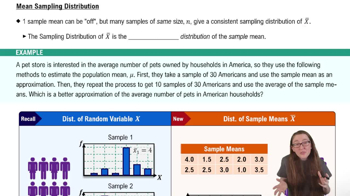
A single sample mean can be unrepresentative due to random variation in the sample. This may result in an estimate that is far from the true population mean.
What does the sampling distribution of the sample mean represent?
It represents the frequency distribution of sample means from many samples of the same size. This distribution shows which sample means are more or less common.
How does increasing the sample size affect the shape of the sampling distribution?
As the sample size increases, the sampling distribution becomes more normal and bell-shaped. Larger sample sizes lead to sample means clustering closer to the population mean.
What is the main advantage of averaging multiple sample means instead of relying on one?
Averaging multiple sample means reduces the impact of outliers and unrepresentative samples. This results in a more reliable estimate of the population mean.
How does the central limit theorem apply to distributions that are not normal?
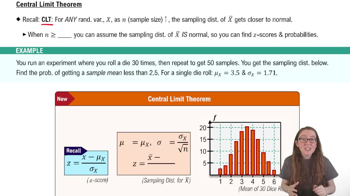
The central limit theorem states that regardless of the original distribution's shape, the sampling distribution of the sample mean approaches normality as sample size increases. This allows normal distribution methods to be used for inference.
Why does the standard deviation of the sampling distribution decrease as sample size increases?
The standard deviation decreases because larger samples tend to be more representative of the population. This reduces the variability between sample means.
What does a z-score represent in the context of the sampling distribution of the sample mean?
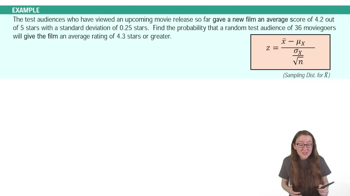
A z-score indicates how many standard errors a sample mean is from the population mean. It is used to calculate probabilities for sample means under the normal distribution.
In the die-rolling example, why is the probability of getting a sample mean less than 2.5 so small?
The probability is small because 2.5 is much lower than the population mean of 3.5, making such a sample mean unlikely with a large sample size. The central limit theorem confirms this rarity by the normality of the sampling distribution.
What role does the central limit theorem play in statistical inference using sample means?
It allows us to use normal distribution techniques, such as z-scores and probability calculations, for sample means when the sample size is sufficiently large. This makes inference about the population mean more accurate and reliable.
 Back
Back
 02:33
02:33