Standard Normal Distribution quiz #1 Flashcards

Standard Normal Distribution quiz #1
Control buttons has been changed to "navigation" mode.
1/40
  • What is a normal distribution?
    A normal distribution is a continuous probability distribution that is symmetric about its mean, with data values more concentrated near the mean and tails that extend infinitely in both directions.
  • What is a standard normal distribution?
    A standard normal distribution is a normal distribution with a mean of 0 and a standard deviation of 1.
  • For a standard normal distribution, which probability is greatest: P(z > 0), P(z < 0), or P(-1 < z < 1)?
    P(-1 < z < 1) is greatest because it covers the central region of the standard normal curve where most data is concentrated.
  • How does the graph of the normal curve change as the mean increases?
    As the mean increases, the entire normal curve shifts to the right along the horizontal axis.
  • About which value is the Student's t-distribution symmetric?
    The Student's t-distribution is symmetric about t = 0.
  • What are the key features of a normal distribution?
    A normal distribution is symmetric, bell-shaped, and characterized by its mean and standard deviation. The mean, median, and mode are equal.
  • What are the properties of the Student's t-distribution?
    The Student's t-distribution is symmetric about zero, has heavier tails than the normal distribution, and its shape depends on the degrees of freedom.
  • How is the t-distribution similar to the standard z-distribution?
    Both distributions are symmetric and bell-shaped, but the t-distribution has heavier tails and depends on degrees of freedom.
  • How do the t-distribution and z-distribution differ?
    The t-distribution has heavier tails and depends on degrees of freedom, while the z-distribution is fixed with mean 0 and standard deviation 1.
  • Which statement does not describe the standard normal distribution?
    A statement that claims the mean is not zero or the standard deviation is not one does not describe the standard normal distribution.
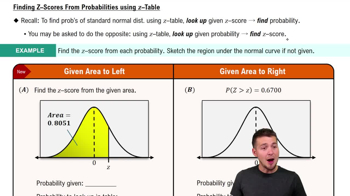
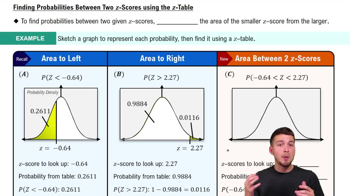
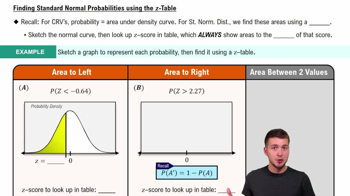
  • How do you match a probability value with the shaded region between z-scores on a normal curve?
    To find the probability between two z-scores, subtract the area to the left of the smaller z-score from the area to the left of the larger z-score.
  • Which statement does not describe the standard normal distribution?
    Any statement that says the mean is not zero or the standard deviation is not one does not describe the standard normal distribution.
  • What happens to the graph of the normal curve as the mean increases?
    The normal curve shifts to the right as the mean increases.
  • What are the properties of the Student's t-distribution?
    The Student's t-distribution is symmetric about zero, has heavier tails than the normal distribution, and its shape depends on degrees of freedom.
  • Which statement does not describe the standard normal distribution?
    Any statement that says the mean is not zero or the standard deviation is not one does not describe the standard normal distribution.
  • For the standard normal probability distribution, what is the total area under the curve?
    The total area under the standard normal curve is 1.
  • What is the total area under the normal curve?
    The total area under the normal curve is 1.
  • What are the characteristics of a normal distribution?
    A normal distribution is symmetric, bell-shaped, and defined by its mean and standard deviation. The mean, median, and mode are equal.
  • Which statements are true of the standard normal distribution?
    The standard normal distribution has a mean of 0, a standard deviation of 1, and is symmetric about the mean.
  • How are the proportions in the tails of a normal distribution described?
    The proportions in the tails of a normal distribution are small compared to the central region, with most data concentrated near the mean.
  • What is true regarding the normal distribution?
    The normal distribution is symmetric, bell-shaped, and most data falls within a few standard deviations of the mean.
  • What percentage of the area under the normal curve lies within one standard deviation of the mean?
    Approximately 68% of the area under the normal curve lies within one standard deviation of the mean.
  • What percent of a standard normal model is found in the central region between z = -1 and z = 1?
    About 68% of the area is found between z = -1 and z = 1 in a standard normal model.
  • Given the mean of a normal distribution, how does the curve change if the mean increases?
    If the mean increases, the normal curve shifts to the right.
  • How is the t-distribution similar to the standard z-distribution?
    Both are symmetric and bell-shaped, but the t-distribution has heavier tails and depends on degrees of freedom.
  • How do you find the area under the normal curve between z = 0.0 and z = 1.79?
    Subtract the area to the left of z = 0.0 from the area to the left of z = 1.79 using the standard normal table.
  • If an observation has a z-score of 0, where does it fall in the standard normal distribution?
    A z-score of 0 corresponds to the mean of the standard normal distribution.
  • How do you find the probability that z is between 0.6 and 2.12 in a standard normal distribution?
    Subtract the area to the left of z = 0.6 from the area to the left of z = 2.12 using the standard normal table.
  • What z-value corresponds to a lower-tail probability of 1% in the standard normal distribution?
    The z-value for a lower-tail probability of 1% is approximately -2.33.
  • Which type of data set best approximates a normal distribution?
    A data set that is symmetric and bell-shaped with most values near the mean best approximates a normal distribution.
  • What is a characteristic of the standard normal probability distribution?
    The standard normal distribution has a mean of 0 and a standard deviation of 1.
  • What are the critical z-values commonly used in hypothesis testing?
    Common critical z-values are ±1.65 for a 90% confidence level and ±1.96 for a 95% confidence level.
  • In a perfectly normal distribution of scores, what is the relationship between mean, median, and mode?
    In a perfectly normal distribution, the mean, median, and mode are all equal.
  • With which normal distribution is the standard normal curve associated?
    The standard normal curve is associated with a normal distribution with mean 0 and standard deviation 1.
  • How do you find P(z ≥ 1.4) in a standard normal distribution?
    Subtract the area to the left of z = 1.4 from 1 to find P(z ≥ 1.4).
  • What are the properties of the Student's t-distribution?
    The Student's t-distribution is symmetric about zero, has heavier tails than the normal distribution, and its shape depends on degrees of freedom.
  • Which statement does not describe the standard normal distribution?
    Any statement that says the mean is not zero or the standard deviation is not one does not describe the standard normal distribution.
  • What is the total area under the normal curve?
    The total area under the normal curve is 1.
  • If an observation has a z-score of 0, what does this indicate?
    A z-score of 0 indicates the observation is at the mean of the distribution.
  • Which random variables are likely to follow a normal distribution?
    Random variables such as heights, test scores, and measurement errors often follow a normal distribution.