Standard Normal Distribution quiz #2 Flashcards
Standard Normal Distribution quiz #2
You can tap to flip the card.
Control buttons has been changed to "navigation" mode.
1/21
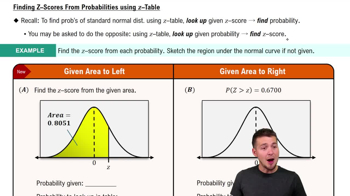
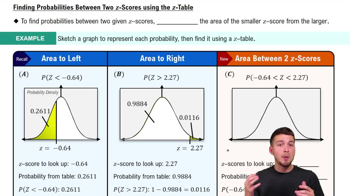
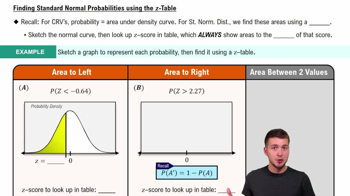
What are the properties of the Student's t-distribution?The Student's t-distribution is symmetric about zero, has heavier tails than the normal distribution, and its shape depends on degrees of freedom.What is the total area under the normal curve?The total area under the normal curve is 1.Given the mean of a normal distribution, how does the curve change if the mean increases?If the mean increases, the normal curve shifts to the right.What proportion of a normal distribution is located between z = -1.75 and z = +1.75?Subtract the area to the left of z = -1.75 from the area to the left of z = +1.75 to find the proportion between these z-scores.Which statement does not describe the standard normal distribution?Any statement that says the mean is not zero or the standard deviation is not one does not describe the standard normal distribution.Which statement does not describe the standard normal distribution?Any statement that says the mean is not zero or the standard deviation is not one does not describe the standard normal distribution.Given the mean of a normal distribution, how does the curve change if the mean increases?If the mean increases, the normal curve shifts to the right.What does a z-score represent in a standard normal distribution?A z-score represents the number of standard deviations an observation is from the mean.How do you find P(z ≥ 1.4) using the standard normal table?Subtract the area to the left of z = 1.4 from 1 to find P(z ≥ 1.4).For a standard normal distribution, what is the probability that z is greater than 1.75?Subtract the area to the left of z = 1.75 from 1 to find the probability that z is greater than 1.75.For a standard normal distribution, which variable always equals 0?The mean of a standard normal distribution always equals 0.For the standard normal probability distribution, what is the area to the right of the mean?The area to the right of the mean in a standard normal distribution is 0.5.If a random variable is normally distributed with mean μ and standard deviation σ, how is its distribution described?Its distribution is symmetric and bell-shaped, centered at μ, with spread determined by σ.How do you find the area of a region under the standard normal curve between two z-scores?Subtract the area to the left of the smaller z-score from the area to the left of the larger z-score.How do you find probabilities based on the standard normal variable z?Use the standard normal table to find the area to the left of the z-score, or subtract from 1 for the area to the right.How do you find the area of a shaded region under the standard normal curve between two z-scores?Subtract the area to the left of the smaller z-score from the area to the left of the larger z-score.How do you find P(-2.50 < z < 1.50) using the standard normal distribution?Subtract the area to the left of z = -2.50 from the area to the left of z = 1.50.What is the range of z-values in a standard normal distribution?The range of z-values in a standard normal distribution is from negative infinity to positive infinity.How do you find P(0 < z < 2.25) using the standard normal distribution?Subtract the area to the left of z = 0 from the area to the left of z = 2.25.If x is normally distributed with a mean of 10, how is its distribution described?Its distribution is symmetric and bell-shaped, centered at 10.For the standard normal probability distribution, what is the area to the left of the mean?The area to the left of the mean in a standard normal distribution is 0.5.