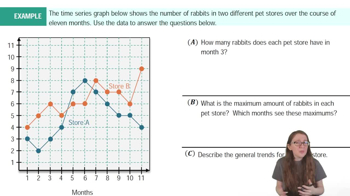
Which type of chart is most useful for displaying how data changes over time?
A time series graph is most useful for displaying how data changes over time.
For what purpose is a time series graph particularly useful in data analysis?
A time series graph is particularly useful for visualizing trends, such as increases and decreases, in a variable's value over time.
What is another name for a time series plot?
A time series plot is also known as a time series graph.
What type of graph best fits the definition 'shows data over time'?
A time series graph best fits the definition 'shows data over time.'
What do the x and y axes represent in a time series graph?
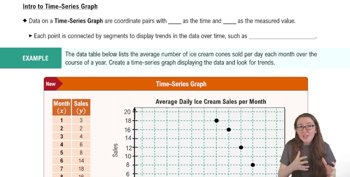
The x-axis represents time intervals, and the y-axis represents the measured value at each time point. This setup allows us to visualize how the variable changes over time.
Why do we connect plotted points with segments in a time series graph?
Connecting the points with segments helps to clearly show trends such as increases or decreases in the data. It makes it easier to interpret changes over time.
What is an example of data suitable for a time series graph as mentioned in the transcript?
Average daily ice cream sales each month over a year is an example. This data is measured over time, making it ideal for a time series graph.
How should you choose the scale for the x-axis when creating a time series graph?
The scale should allow you to see the entire range of time over which data was measured. For example, if measuring by months, increment the x-axis by ones to cover all months.
How can you identify periods of increase or decrease in a time series graph?
Periods of increase are shown when the graph heads upward, while periods of decrease are shown when the graph heads downward. Observing the direction between connected points reveals these trends.
What should you verify after plotting points on a time series graph?
You should check that each point matches the corresponding data from the table. This ensures accuracy before connecting the points to analyze trends.