Skip to main content
Introductory Statistics
My Course
Learn
Exam Prep
AI Tutor
Study Guides
Textbook Solutions
Flashcards
Explore
Try the app
My Course
Learn
Exam Prep
AI Tutor
Study Guides
Textbook Solutions
Flashcards
Explore
Try the app
Back
Two Means - Known Variance definitions
You can tap to flip the card.
Hypothesis Test
You can tap to flip the card.
👆
Hypothesis Test
A procedure to assess evidence for a claim about population means using sample data and statistical calculations.
Track progress
Control buttons has been changed to "navigation" mode.
1/15
Related flashcards
Related practice
Recommended videos
Two Means - Known Variance quiz
Two Means - Known Variance
15 Terms
Two Means - Known Variance
10. Hypothesis Testing for Two Samples
5 problems
Topic
Justin
10. Hypothesis Testing for Two Samples - Part 1 of 2
5 topics
12 problems
Chapter
Brendan
10. Hypothesis Testing for Two Samples - Part 2 of 2
1 topic
2 problems
Chapter
Ernest
Guided course
02:44
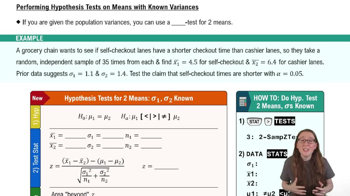
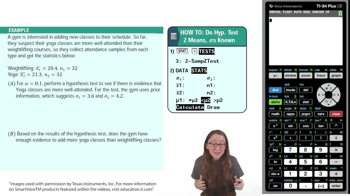
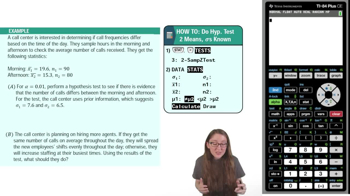
Means Known Variances Hypothesis Test Using TI-84 Example 2
224
views
Guided course
05:05
Means Known Variances Hypothesis Test Using TI-84
418
views
6
rank
Guided course
02:51
Means Known Variances Hypothesis Test Using TI-84 Example 1
231
views
Terms in this set (15)
Hide definitions
Hypothesis Test
A procedure to assess evidence for a claim about population means using sample data and statistical calculations.
Null Hypothesis
A statement asserting no difference between population means, serving as the default assumption in testing.
Alternative Hypothesis
A statement proposing a difference or specific relationship between population means, opposing the null.
Population Standard Deviation
A known measure of variability within a population, used in calculations for z-tests involving two means.
Sample Mean
An average value calculated from a sample, used to estimate the corresponding population mean.
Sample Size
The number of observations in each group, influencing the reliability and validity of statistical results.
Z-Test
A statistical method for comparing two means when population standard deviations are known, using the z-score.
Z-Score
A value indicating how many standard deviations a sample mean difference is from the hypothesized difference.
P-Value
A probability quantifying the evidence against the null hypothesis, guiding decision-making in hypothesis testing.
Significance Level
A threshold, often denoted by alpha, determining when to reject the null hypothesis based on the p-value.
Independent Sample
A group of observations collected without influence from other samples, ensuring valid statistical inference.
Random Sample
A selection method where each member of the population has an equal chance of being chosen, reducing bias.
Normal Distribution
A bell-shaped probability distribution required for certain statistical tests, especially with smaller sample sizes.
Two-Sample Z-Test
A specific z-test comparing means from two independent samples with known population standard deviations.
Alpha
A preset probability threshold for error, commonly set at 0.05, used to judge statistical significance.
 BackBack

 02:44
02:44