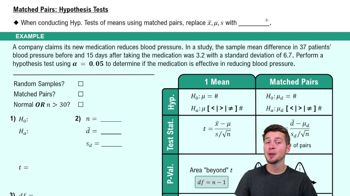
When testing the difference of means for paired data, what statistical method is appropriate and how are the variables adjusted compared to independent samples?
For paired data, the appropriate statistical method is the paired t-test. In this test, variables such as the sample mean (x̄), population mean (μ), and standard deviation (s) are replaced with their difference equivalents: sample mean difference (d̄), population mean difference (μd), and standard deviation of the differences (sd). The test focuses on the differences between paired observations rather than the individual sample means.
What is an example of a dependent sample that could use the paired t-test?
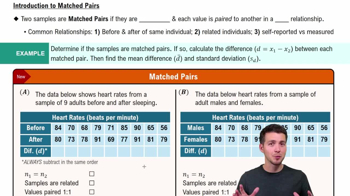
An example of a dependent sample suitable for the paired t-test is a before-and-after study on the same individuals, such as measuring the heart rate of adults before and after sleeping, or recording blood pressure before and after taking medication. In these cases, each individual's measurements are paired, making the samples dependent.
Which types of samples are most likely to be considered dependent samples in statistical analysis?
Samples are most likely to be considered dependent if they involve a before-and-after comparison of the same individuals, measurements from related individuals (such as siblings, partners, or coworkers), or paired data where each value in one sample is uniquely matched to a value in the other sample. The key is a one-to-one relationship between the paired values.
Two samples are considered __________ if the sample values are paired in a one-to-one relationship.
Two samples are considered dependent (matched pairs) if the sample values are paired in a one-to-one relationship.
What is the most important criterion for determining if two samples are matched pairs?
The most important criterion is that each value in one sample can be uniquely paired with a value in the other sample, forming a one-to-one relationship. This pairing must be based on a meaningful connection, such as before-and-after measurements on the same individual.
Why must the sample sizes be equal when identifying matched pairs?
Sample sizes must be equal because each observation in one sample must be paired with exactly one observation in the other sample. If the sizes differ, a one-to-one pairing is not possible.
How do you calculate the mean difference (d̄) in a matched pairs dataset?
To calculate the mean difference, subtract the paired values in a consistent order for each pair and then find the average of these differences. The result is denoted as d̄ and represents the sample mean difference.
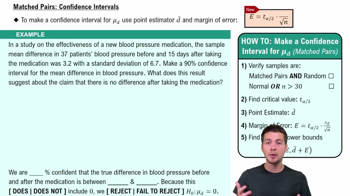
What does it mean if the confidence interval for the mean difference in a matched pairs study does not include zero?
If the confidence interval does not include zero, it suggests there is a statistically significant difference between the paired measurements. This means the null hypothesis of no difference can be rejected.
How is the margin of error for a confidence interval in matched pairs calculated?
The margin of error is calculated by multiplying the critical t-value by the standard deviation of the differences (sd) divided by the square root of the number of pairs. This formula accounts for the variability and sample size in the paired differences.
In a matched pairs hypothesis test, what does the alternative hypothesis typically state when testing for a reduction in a measurement?
The alternative hypothesis typically states that the mean difference (μd) is greater than zero if the difference is calculated as before minus after and a reduction is expected. This reflects the expectation that the measurement decreases after the intervention.