Skip to main content
Introductory Statistics
My Course
Learn
Exam Prep
AI Tutor
Study Guides
Textbook Solutions
Flashcards
Explore
Try the app
My Course
Learn
Exam Prep
AI Tutor
Study Guides
Textbook Solutions
Flashcards
Explore
Try the app
Back
Two Means - Unknown, Equal Variance quiz
You can tap to flip the card.
What assumption allows us to use the pooled standard deviation in a two means hypothesis test?
You can tap to flip the card.
👆
What assumption allows us to use the pooled standard deviation in a two means hypothesis test?
We assume that the two populations have equal variances, which allows us to use the pooled standard deviation.
Track progress
Control buttons has been changed to "navigation" mode.
1/15
Related flashcards
Related practice
Recommended videos
Two Means - Unknown, Equal Variance definitions
Two Means - Unknown, Equal Variance
15 Terms
Two Means - Unknown, Equal Variance
10. Hypothesis Testing for Two Samples
5 problems
Topic
Justin
10. Hypothesis Testing for Two Samples - Part 1 of 2
5 topics
12 problems
Chapter
Brendan
10. Hypothesis Testing for Two Samples - Part 2 of 2
1 topic
2 problems
Chapter
Ernest
Guided course
06:20
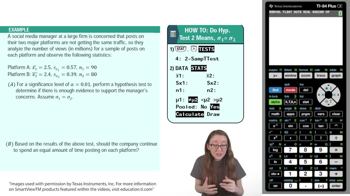
Means Unknown Equal Variances Hypothesis Test Using TI-84
464
views
2
rank
Guided course
03:34
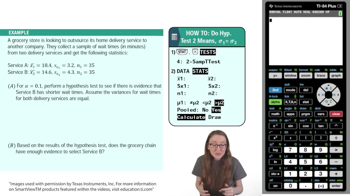
Means Unknown Equal Variances Hypothesis Test Using TI-84 Example 2
228
views
1
rank
Guided course
03:10
Means Unknown Equal Variances Hypothesis Test Using TI-84 Example 1
235
views
Terms in this set (15)
Hide definitions
What assumption allows us to use the pooled standard deviation in a two means hypothesis test?
We assume that the two populations have equal variances, which allows us to use the pooled standard deviation.
How is the pooled standard deviation calculated?
It is calculated as a weighted average of the two sample variances, providing a better approximation for the population standard deviation.
What is the null hypothesis when testing two means with equal variances?
The null hypothesis is that the two population means are equal, or mu1 = mu2.
What is the alternative hypothesis if you want to test if a new method improves scores?
The alternative hypothesis is that the mean of the old method is less than the mean of the new method, or mu1 < mu2.
What information do you need from each sample to perform the test?
You need the sample mean, sample standard deviation, and sample size from each group.
What changes in the t-score formula when using pooled standard deviation?
The denominator uses the pooled standard deviation instead of the individual sample standard deviations.
How do you find the degrees of freedom for this test?
Add the sample sizes of both groups, subtract one from each, and sum the results: (n1 - 1) + (n2 - 1).
What is the next step after calculating the t-score?
Turn the t-score into a p-value using a t-table or calculator.
How do you determine whether to reject the null hypothesis?
Compare the p-value to the significance level (alpha); if the p-value is less than alpha, reject the null hypothesis.
What does rejecting the null hypothesis indicate in this context?
It indicates there is enough evidence to support the alternative hypothesis, such as improved test scores with the new method.
What sample size condition must be met for valid results?
Each sample size should be greater than 30 to satisfy normality assumptions.
What type of samples are required for this test?
Independent random samples are required.
What is the significance level (alpha) used in the example?
The significance level used is 0.05.
What was the calculated t value in the example provided?
The t value calculated was approximately -5.43.
What was the p-value obtained in the example, and what does it mean?
The p-value was approximately 2.05 x 10^-7, which is much less than alpha, so the null hypothesis is rejected.
 BackBack

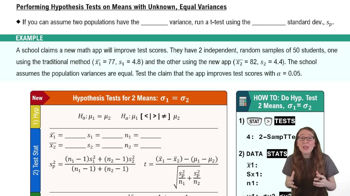
 06:20
06:20